These are the notes from my talk on applied AI at a business club on November 7, 2026. The topic: can AI let you cut people, or your hiring plan, without losing productivity. The talk ran for about 70 minutes, followed by another 55 minutes of questions. The talk was given in Russian, and the slides below are shown as they were presented.
- Speaker view (in Russian): slide on the left, notes on the right, arrow keys to move through.
- PDF to pass along (in Russian): the same notes, page by page.
Times are measured from the start of the recording and reconstructed from the amount of speech, so they are approximate. Quotes are close to verbatim. Surnames of third parties are abbreviated.
Key points
- The technology is already "100% smart." The bottleneck is adaptation: of people, processes and interfaces.
- About $5 trillion of knowledge work is flowing into AI, which is roughly 25 times cheaper. Labor's share of value creation has fallen from 65% to 58% and could lose another 10–15 percentage points in 2–3 years.
- Organic adoption gives you 5% enthusiasts and almost nothing on EBITDA. To get +10%, you have to raise the average level of every department.
- A company should be split into data, brains and interface. Most often it is the brains that change; the interface should be left alone.
- Layoffs are planned like hiring: onboarding, offboarding, data capture, a cooldown, a reconciliation with HR and product.
- Monopolies are better off waiting 8–18 months. Everyone else needs a fast test, an external team on a fixed fee plus a percentage, and read-only access only.
Introduction
01. Cover · ≈0:00–0:06
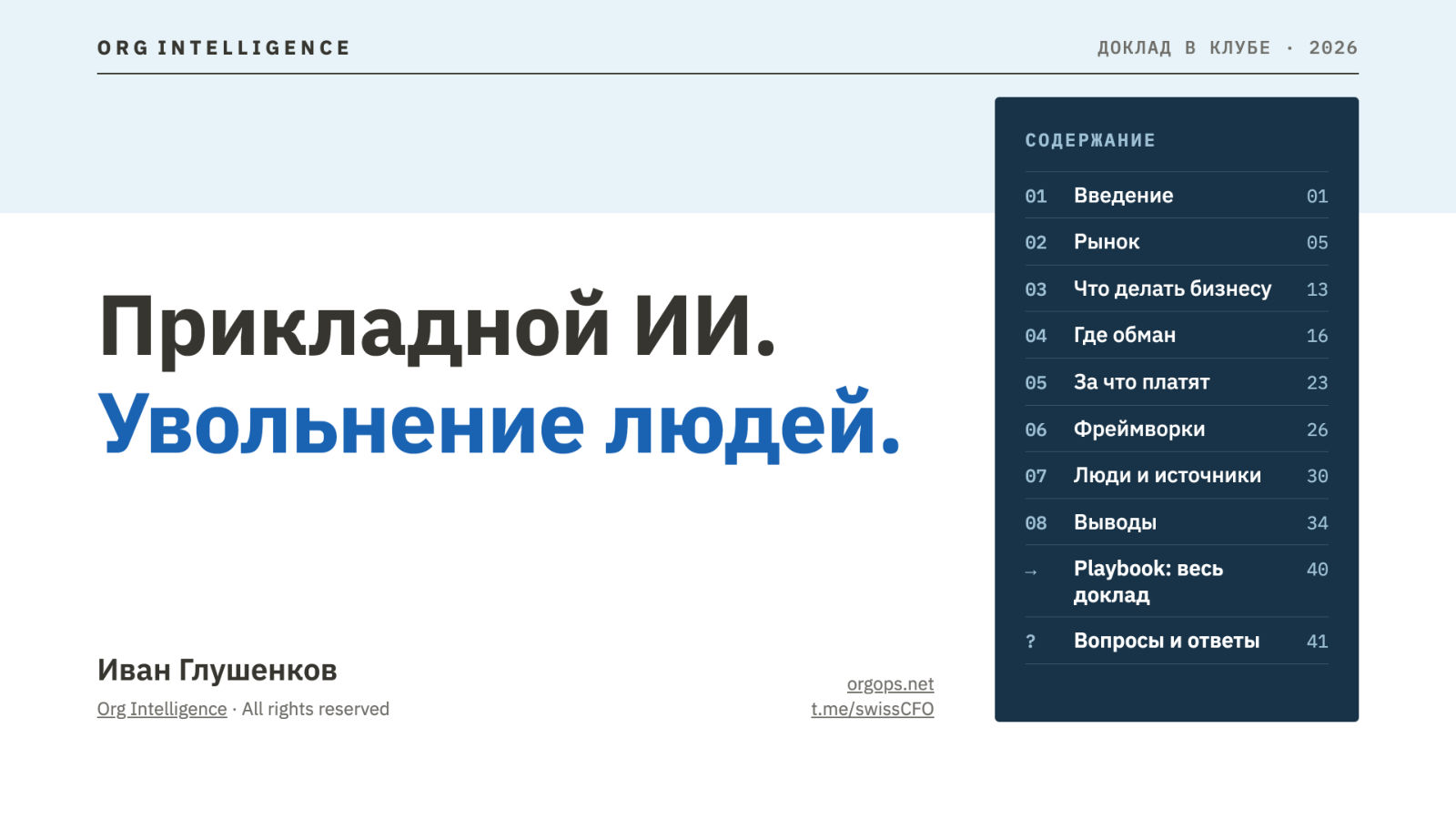
- 0:00 — Connecting, screen sharing. Ivan asks for the recording to be turned on: "a couple of people asked," but in a way "that those who didn't want to be exposed aren't exposed."
- 0:01 — Chat before the start, unrelated to the talk.
- 0:05 — Mikhail: "You're the first person who managed to get a presentation running here right away." Ivan asks to be pinged after 30 minutes if he "gets carried away." Questions come at the end.
02. Ivan Glushenkov · ≈0:06–0:08
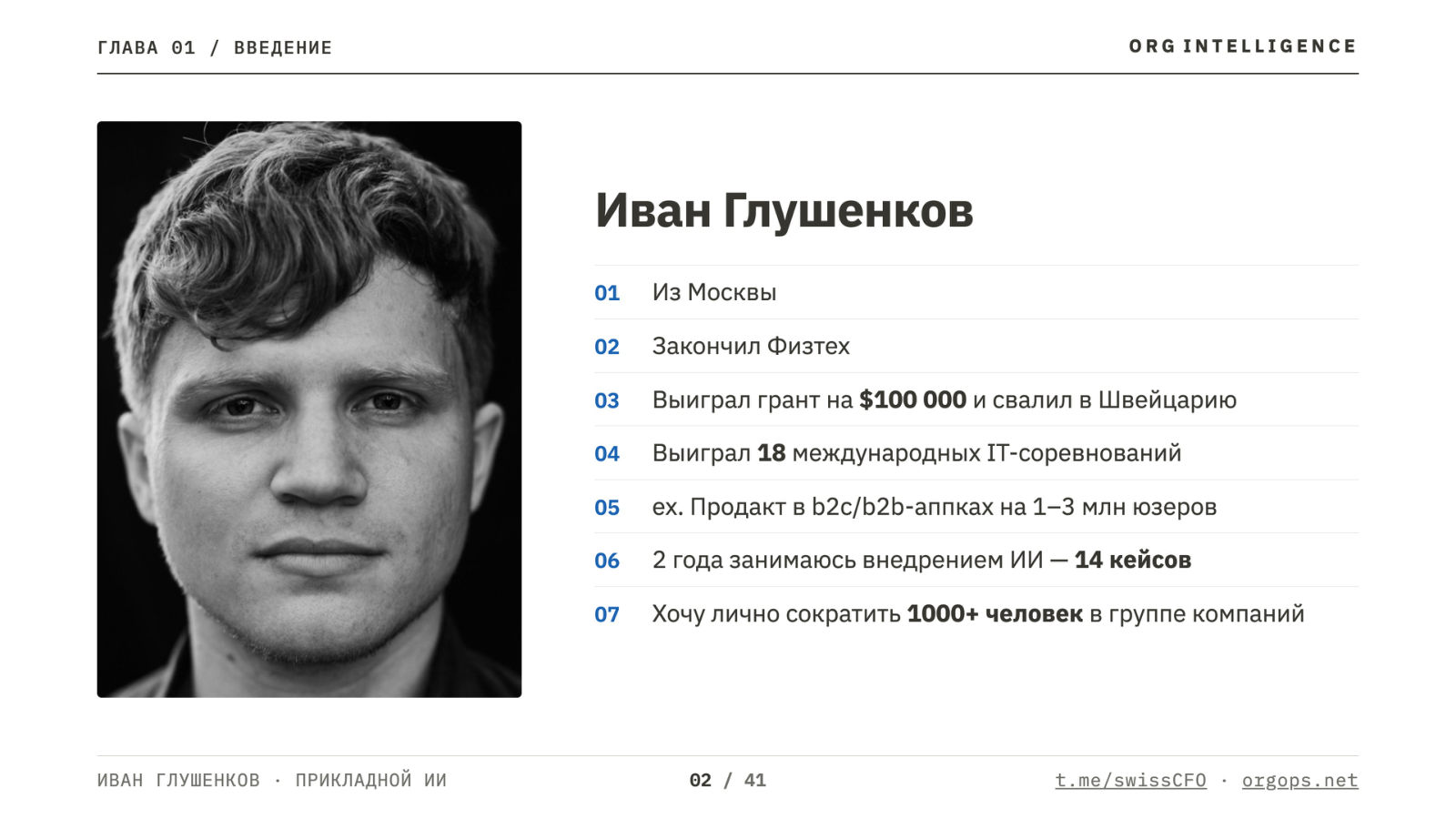
- 0:06 — The opener: "We've already talked about hauling away dead people. But before they die, you first have to strip them of every economic incentive. So today we'll talk about AI and about firing people." He hasn't fired thousands yet — "maybe a hundred and fifty."
- 0:07 — Moscow, MIPT (Phystech), "from an ordinary family." A $100,000 grant, Switzerland since 2021. 18 international hackathons, product manager in B2B/B2C with 1.3 million users.
- 0:08 — In finance with AI cases since 2024, 14 companies. The goal: "to cut 1,000+ people in some group of companies… without any nasty surprises or irritation for the business."
03. The aim of the talk · ≈0:08–0:09
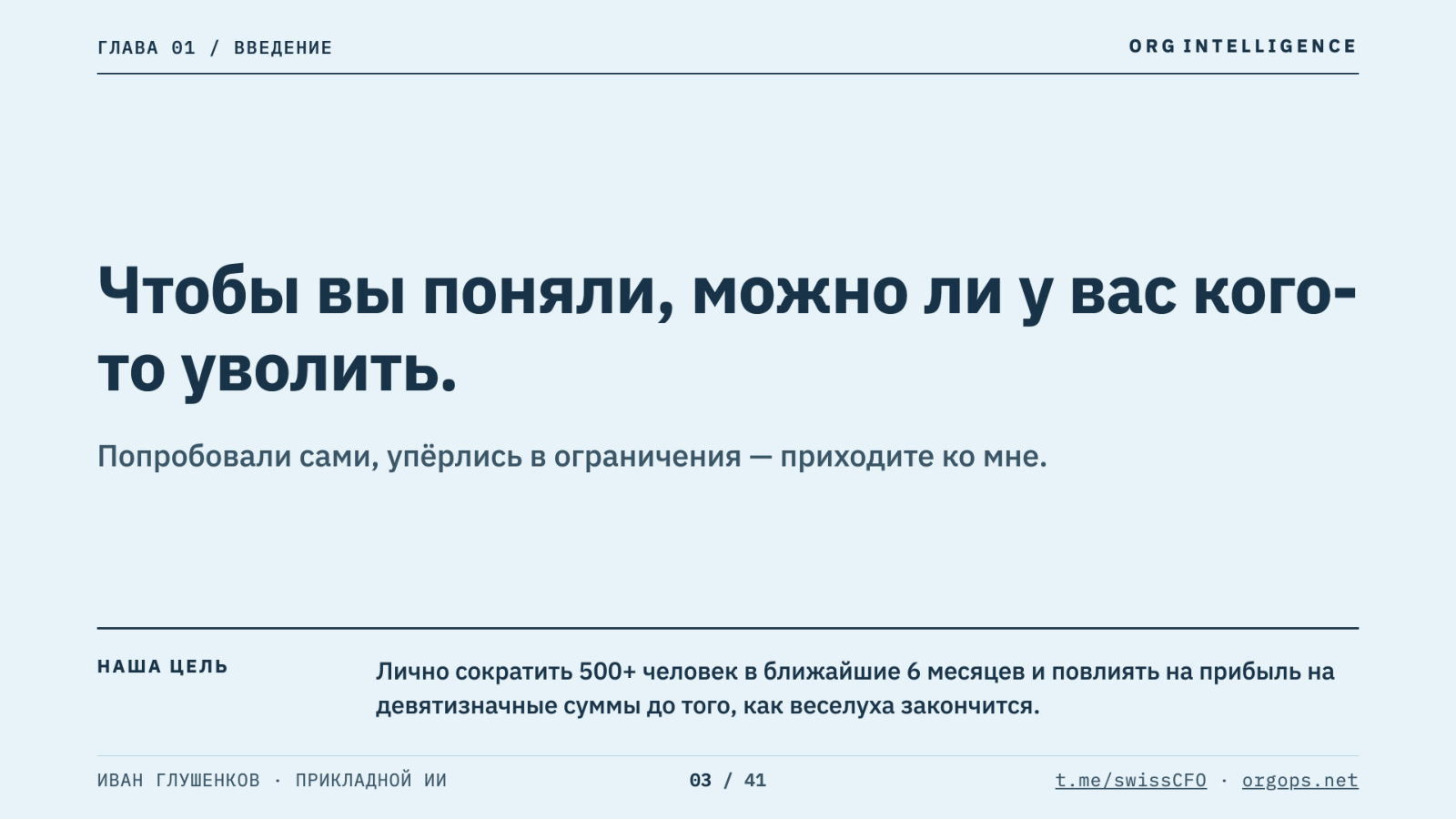
- 0:08 — "So that you understand whether you can let someone go or cut your hiring plan without losing productivity," and can try it yourselves. The material can be loaded into an agent and handed to your team.
- 0:09 — It is useful for those who don't succeed, too: they "come back with better budgets and better questions."
04. What we'll cover · ≈0:09–0:10
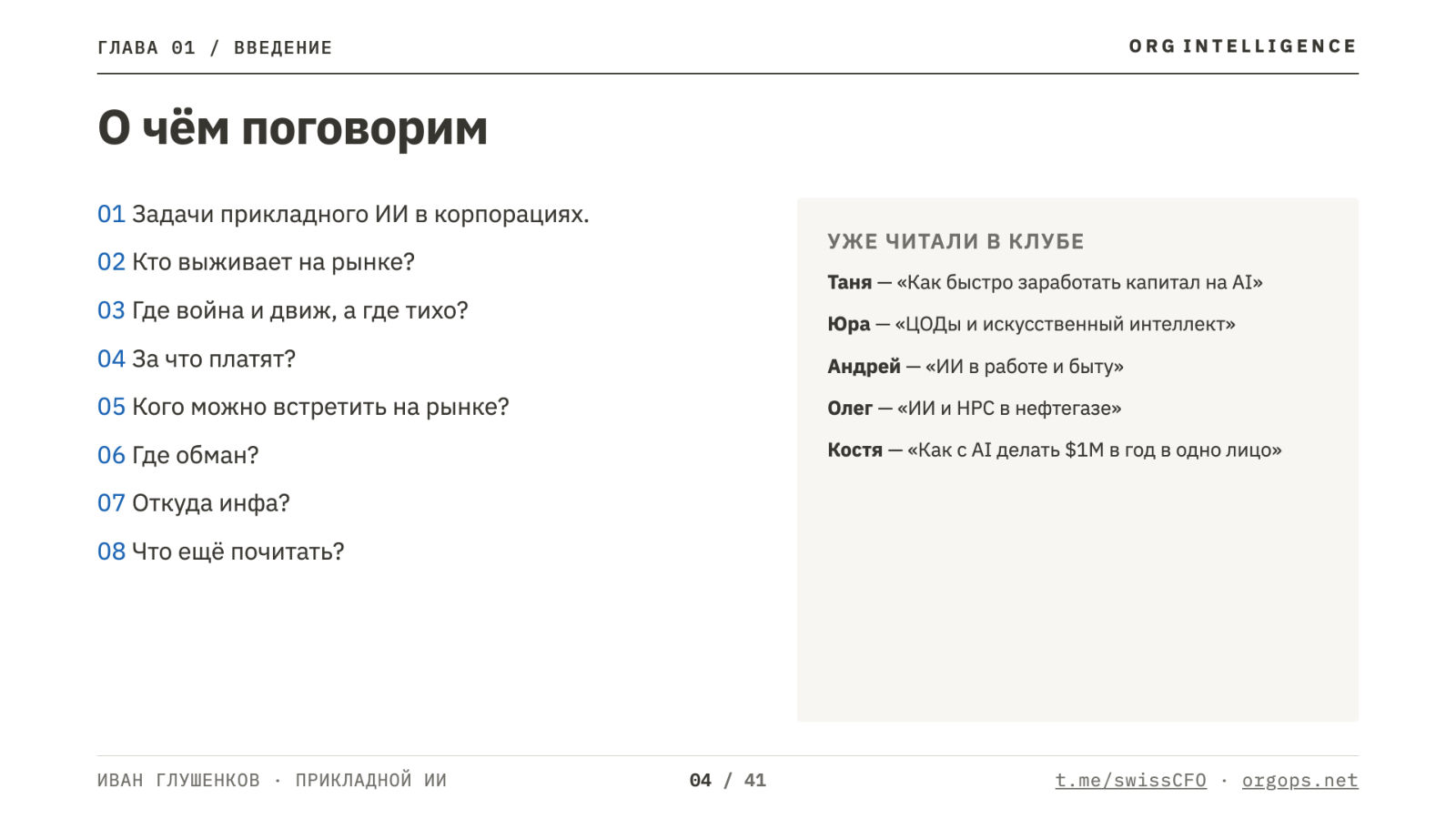
- 0:09 — The plan: what applied AI is asked to do; who survives, where the war is, where it's quiet; what people pay for; who is in the market; the big picture.
- 0:10 — The club has already had lectures by Tanya, on data centers, on AI in oil and gas, and by Kostya. This one is about "how implementation in corporations actually happens out in the real economy, and what it does to the P&L."
The market
05. What the requests sound like · ≈0:10–0:12
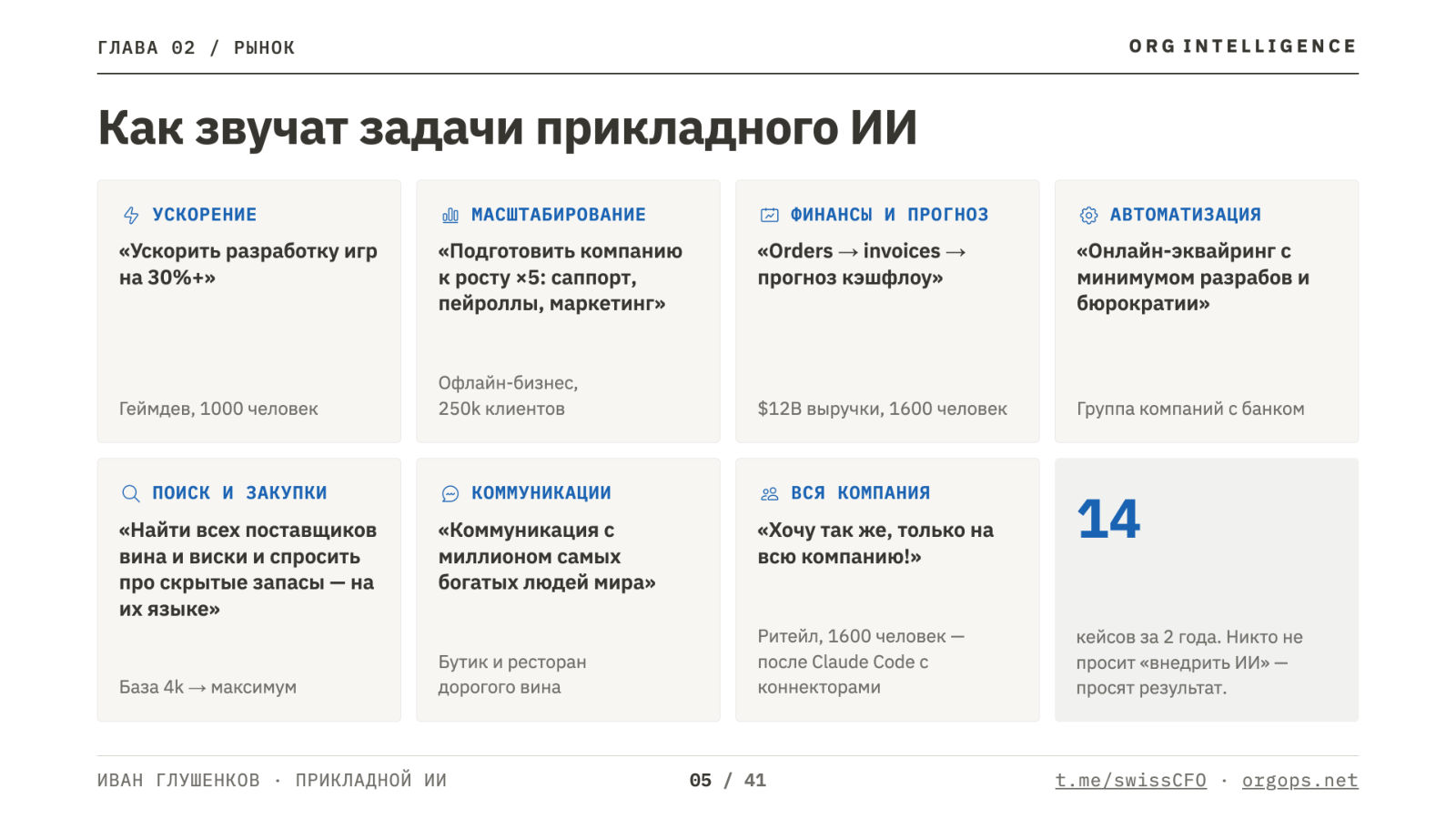
- 0:10 — Speed up game development by 30% (iGaming, 1,000 people). Prepare a French company for 5× growth: support, payroll and marketing don't scale without people.
- 0:11 — Commodity trading: orders → receipts → cash-flow forecast. Online acquiring with a minimum of bureaucracy. Suppliers of expensive wines: "there were four in the database… it turned out there were 22,000 of them," and an AI agent called every one of them in their own language.
- 0:11 — Communication with the million richest people in the world; ≈100,000 reached.
- 0:12 — A typical request: "The founder discovered Claude Code… let's do the same for the whole company." Nobody asks to implement AI; everyone asks for a result.
06. Megatrend 1: labor → AI · ≈0:12–0:13
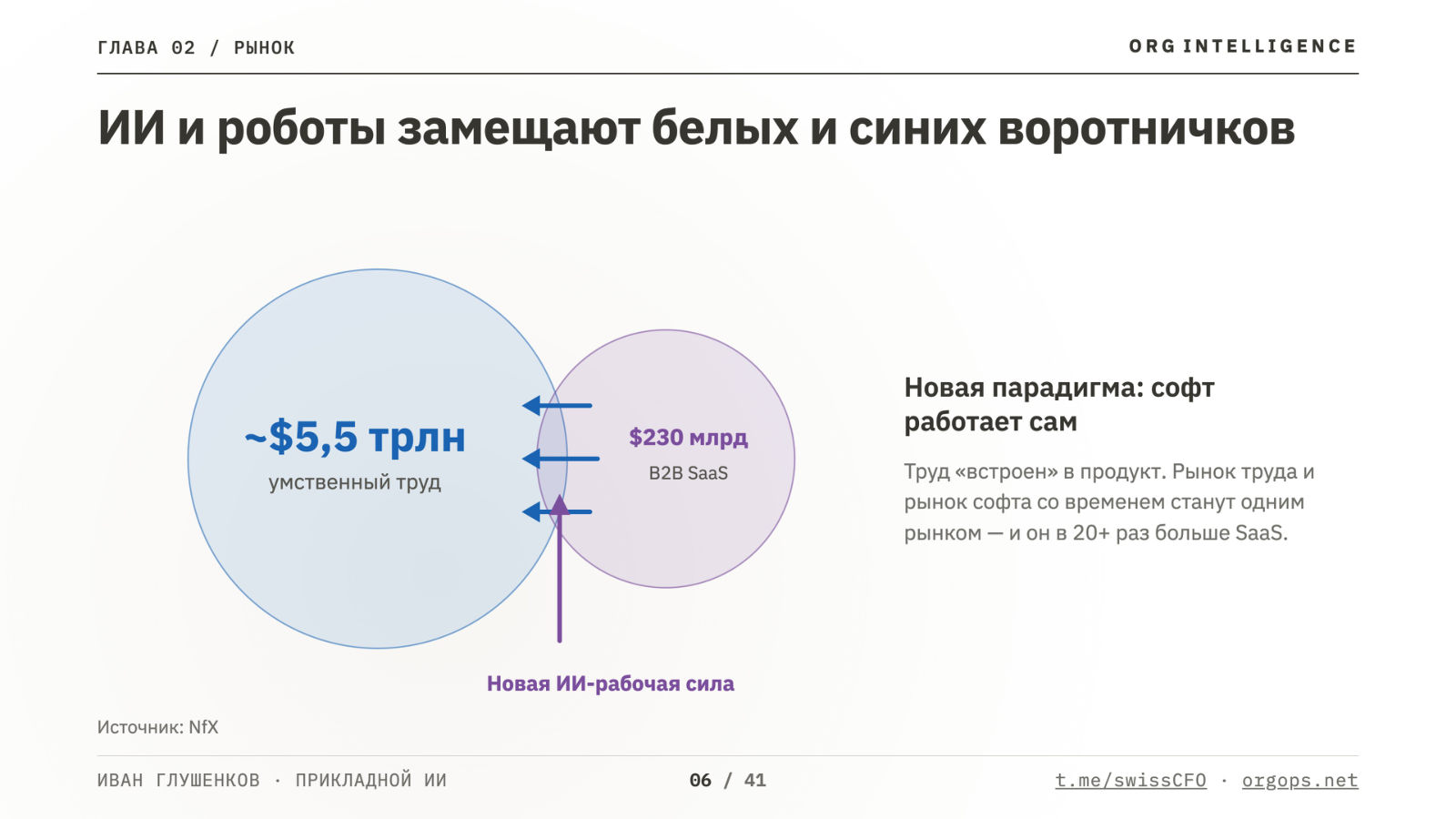
- 0:12 — ≈$5 trillion is spent on knowledge work. B2B SaaS was 20–25 times smaller. "AI plays on both flanks at once": it replaces both labor and SaaS.
- 0:13 — Hence "the pull of expensive labor flowing… into a new market that costs 25 times less."
07. Megatrend 2: value moves to capital · ≈0:13–0:15
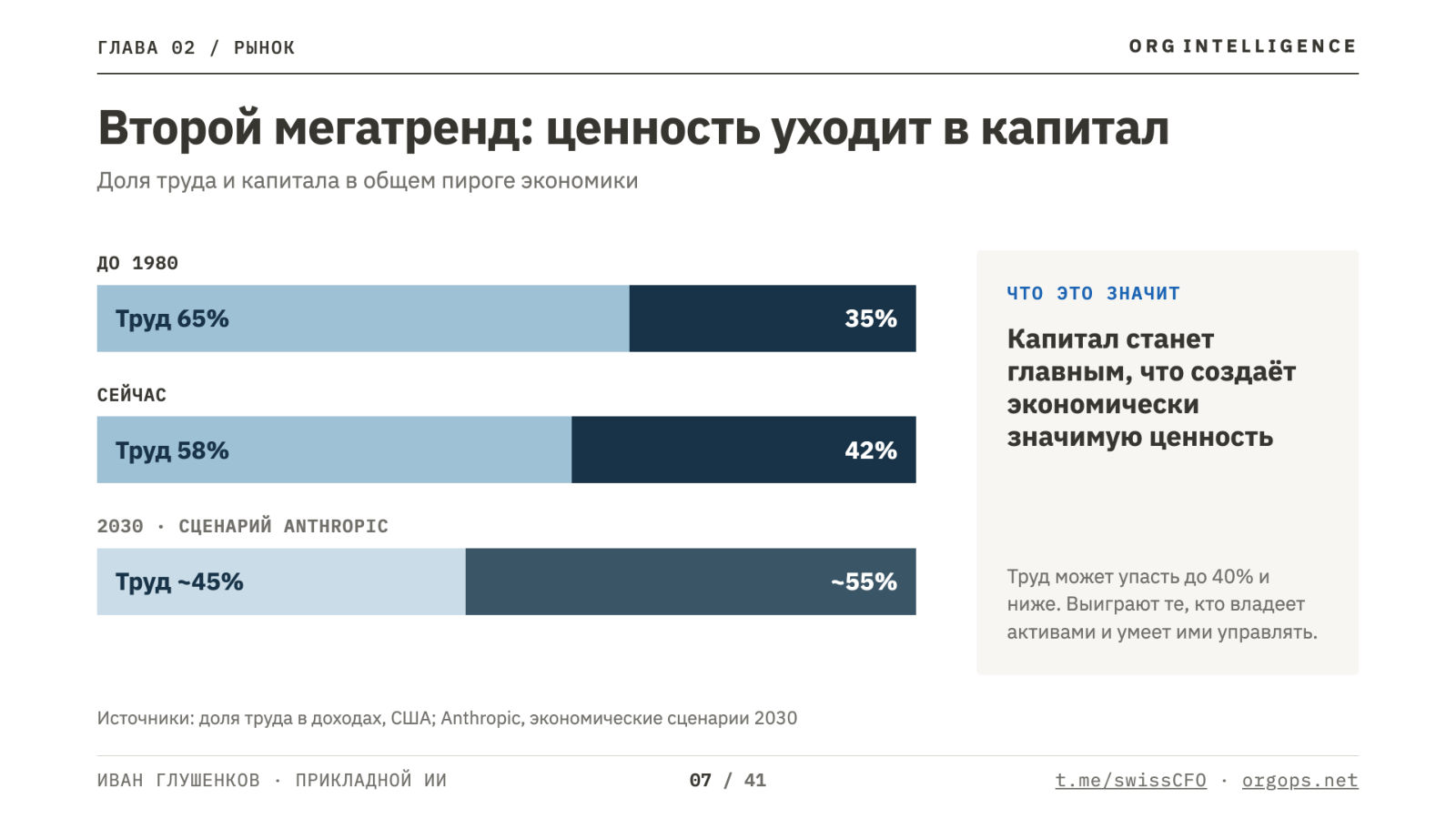
- 0:13 — 50 years ago: labor 65%, capital 35%. Now it is 58% to 42%. Capital is money, and factories, and IP, and electricity.
- 0:14 — "It used to take 50 years, and now it could happen in 2–3 years… fall by another 10–15%, just like that." A mentor from finance showed him a pie chart, "65% → could become 30": "Damn, yes, that's brilliant."
- 0:15 — Capital is more liquid and it compounds. The trend is an old one: "it's not something that… showed up 5 years ago, like ChatGPT."
08. Asset management · ≈0:15–0:17
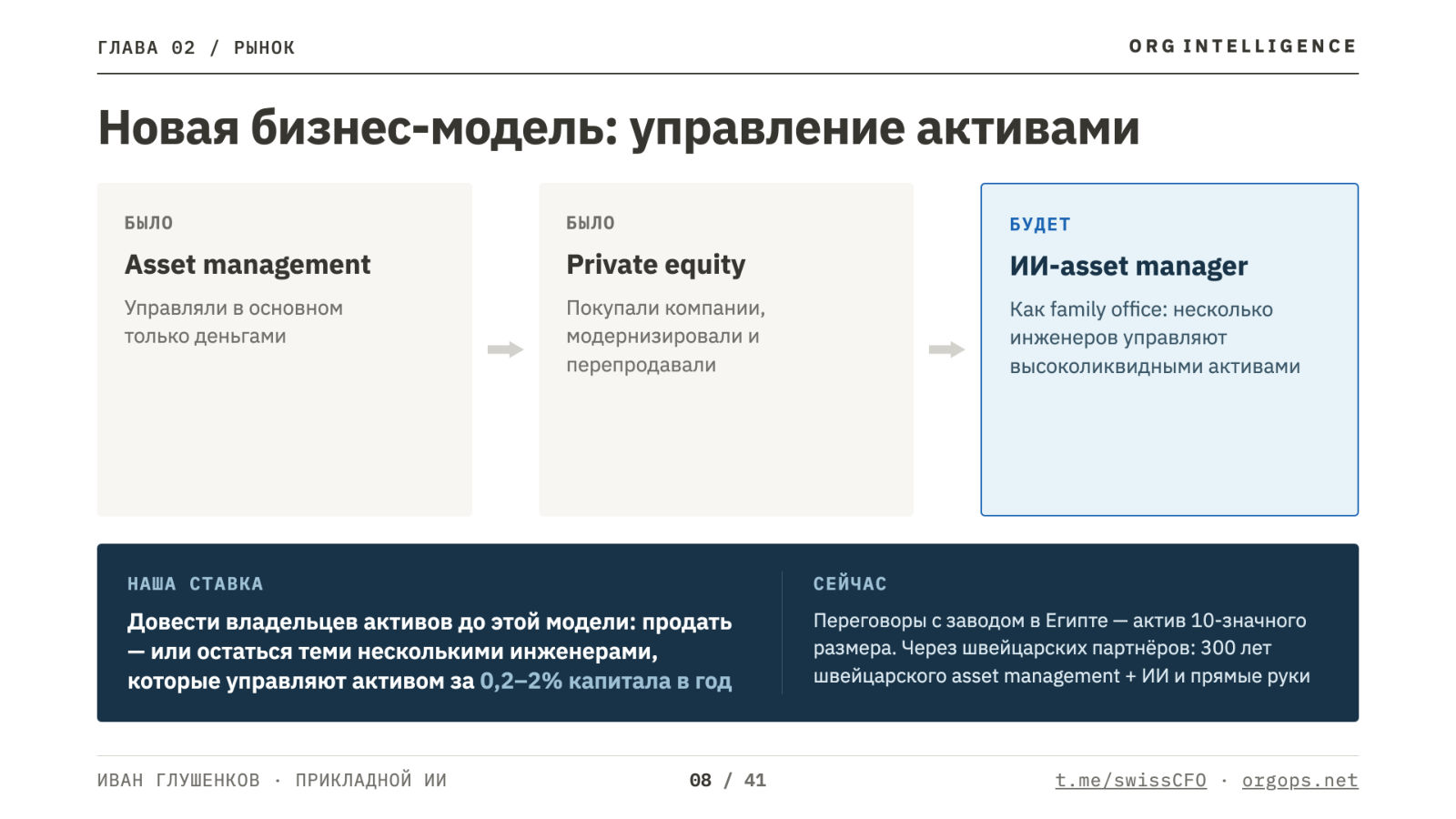
- 0:15 — Managing large assets used to mean a lot of people. Now "a large asset can be managed by a very small number of people."
- 0:16 — The players are PE, new companies and the state. The target is "0.2–2% a year for management." "Maybe the whole economy will end up there… Not now, but you'll be able to."
09. How I ended up here · ≈0:17
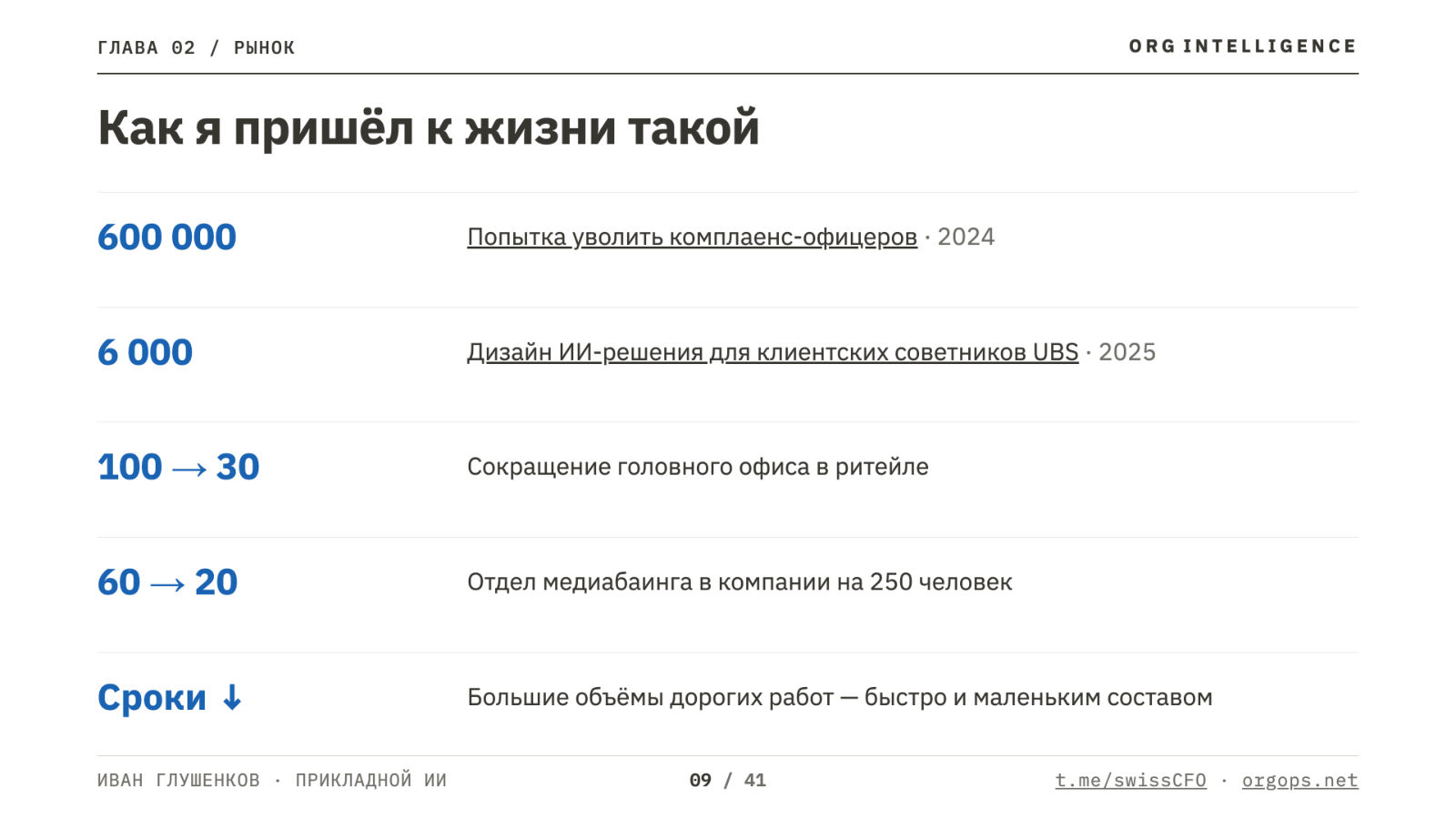
- 0:17 — Moving on to the personal story: "Firing thousands of employees was on the bill, so I'd like to tell you about it." The four cases on the slide are covered below.
10. Checking a single payment · ≈0:17–0:27
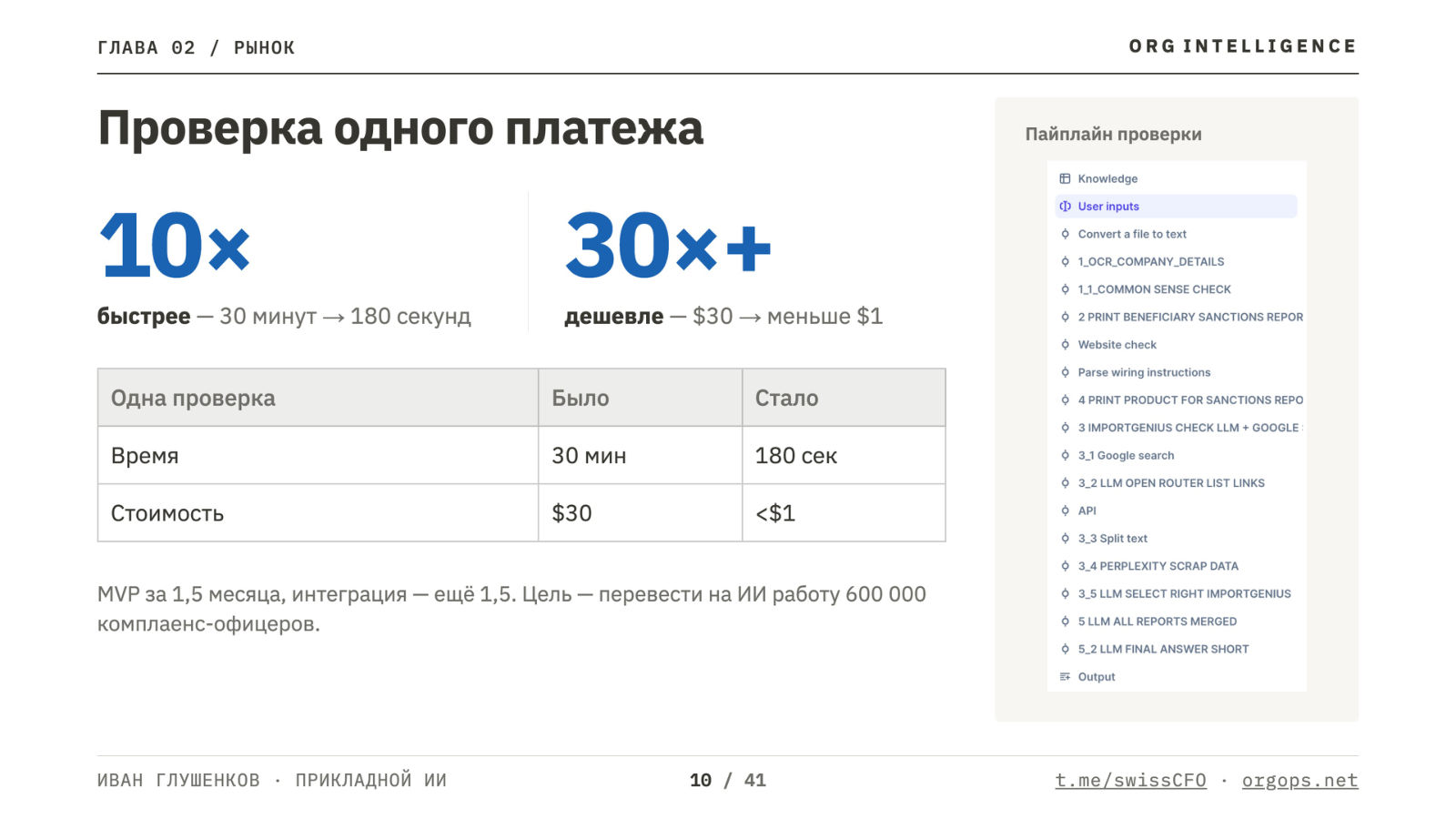
- 0:17 — 2024: Yura G. came along; payments were being checked by hand, ≈$30 and 30 minutes each. "Why, when ChatGPT already exists?" An MVP in 1.5 months: under $2 and under 3 minutes. Another 1.5 months to production "with superhuman performance."
- 0:19 — 600,000 compliance officers in the world, $24–60 billion a year. They applied to YC and found "around fifty-six companies… And that was pretty much the end of it."
- 0:20 — UBS: 6,000 advisors, ≈$600 million a year, 20% of their time spent on preparation and notes. 1,400 calls; the action points were solved "in about three hours." They built it end to end: a brief before the call, prompts from 2,500 pages of product documents during it, an action summary after. 1st place from UBS, 3rd overall.
- 0:23 — ≈1,200 people could be cut, or you could "spend their time… on improving the quality of service" — companies more often choose the second.
- 0:24 — French retail, 1,600 people: the office went from 100 to 30, "paralysis" after M&A. They found €1 million of fraud and set up analytics.
- 0:25 — Advertising for banks, $5 million a month: "We didn't change the interface… didn't change the data, but we changed the brains." It used to be five people per client; now it is one and a half.
- 0:26 — What sells best right now is a large volume of expensive work done "by a fast, small team."
11. How adoption happens · ≈0:27–0:28
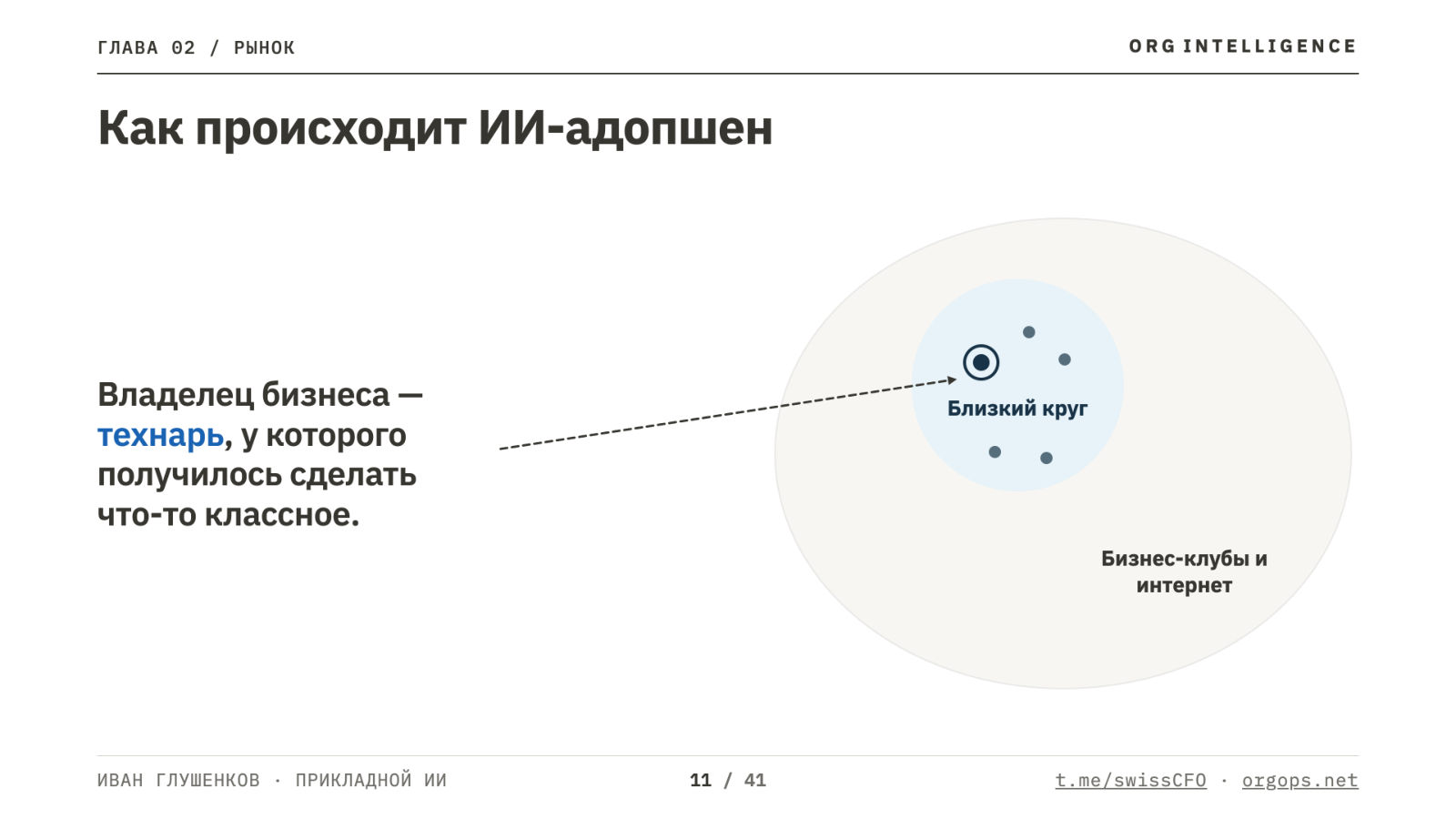
- 0:27 — For technical people "everything already works… they don't need any agencies." Their circle finds out what "really worked" and wants the same. A technical founder won't go and do someone else's transformation end to end — Ivan's business model lives in that gap.
12. Where the war is and where it's quiet · ≈0:28–0:33
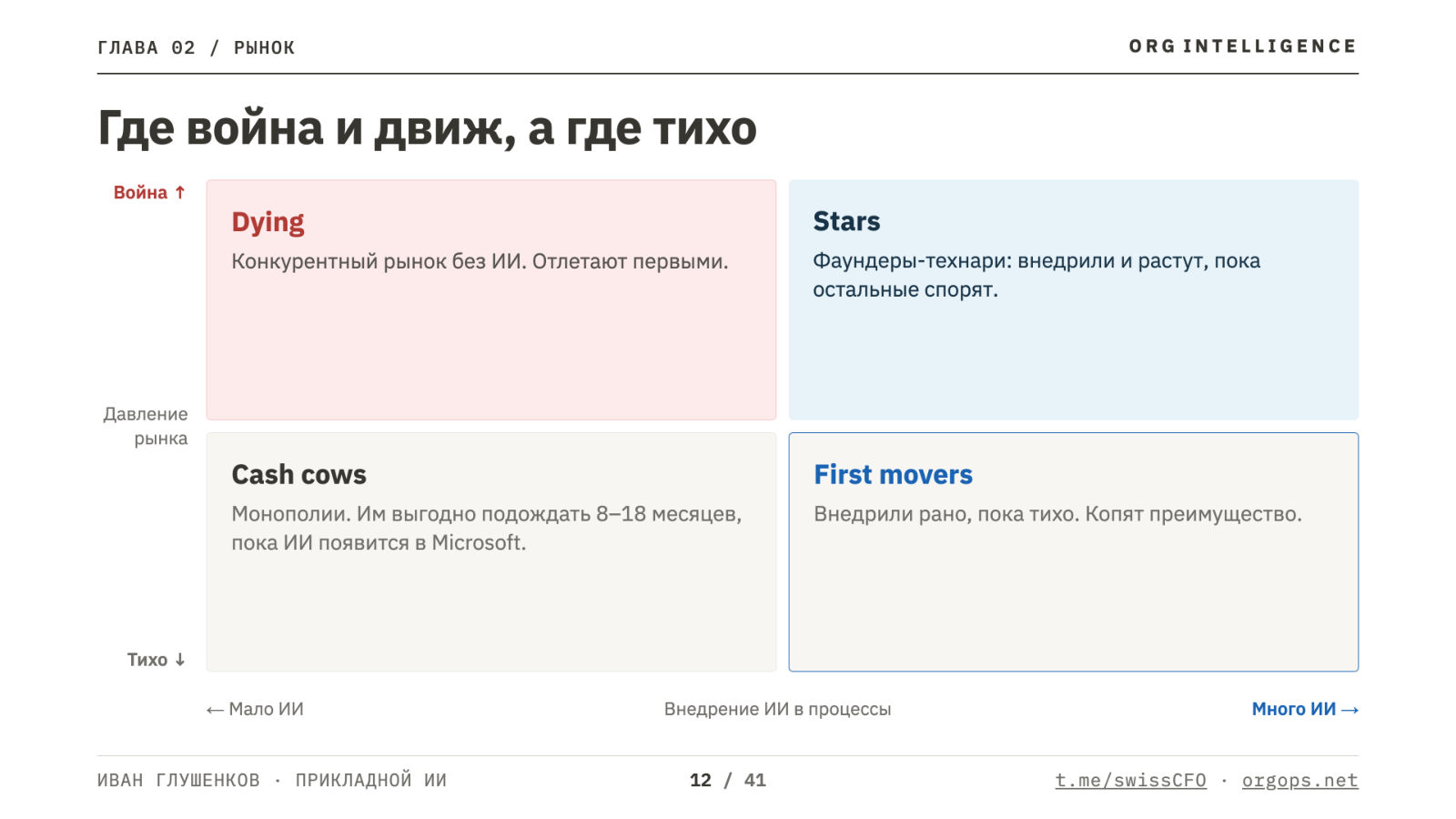
- 0:28 — Monopolies: a chemical plant with 90,000 people. McKinsey calculated 27% cuts over 4 years, "took its $10 million and left." The rollout is being done by an internal consulting team of 200.
- 0:29 — Microsoft and Google are building AI in: "it's still total garbage, but… it will be a good deal." "If you can afford to wait 8–18 months and do nothing… that's a good strategy."
- 0:30 — The dying: you can sell to them, if they understand that they are. "A customer base is always a very good moat."
- 0:31 — Tech founders with AI (Sergey among them) are "great guys… but there's no deal for us with them."
- 0:32 — AI-native organizations like Jack Dorsey's payments companies: "there are very, very, very few of those," about 20 companies.
What a business should do
13. What a business should do: theory · ≈0:33–0:34
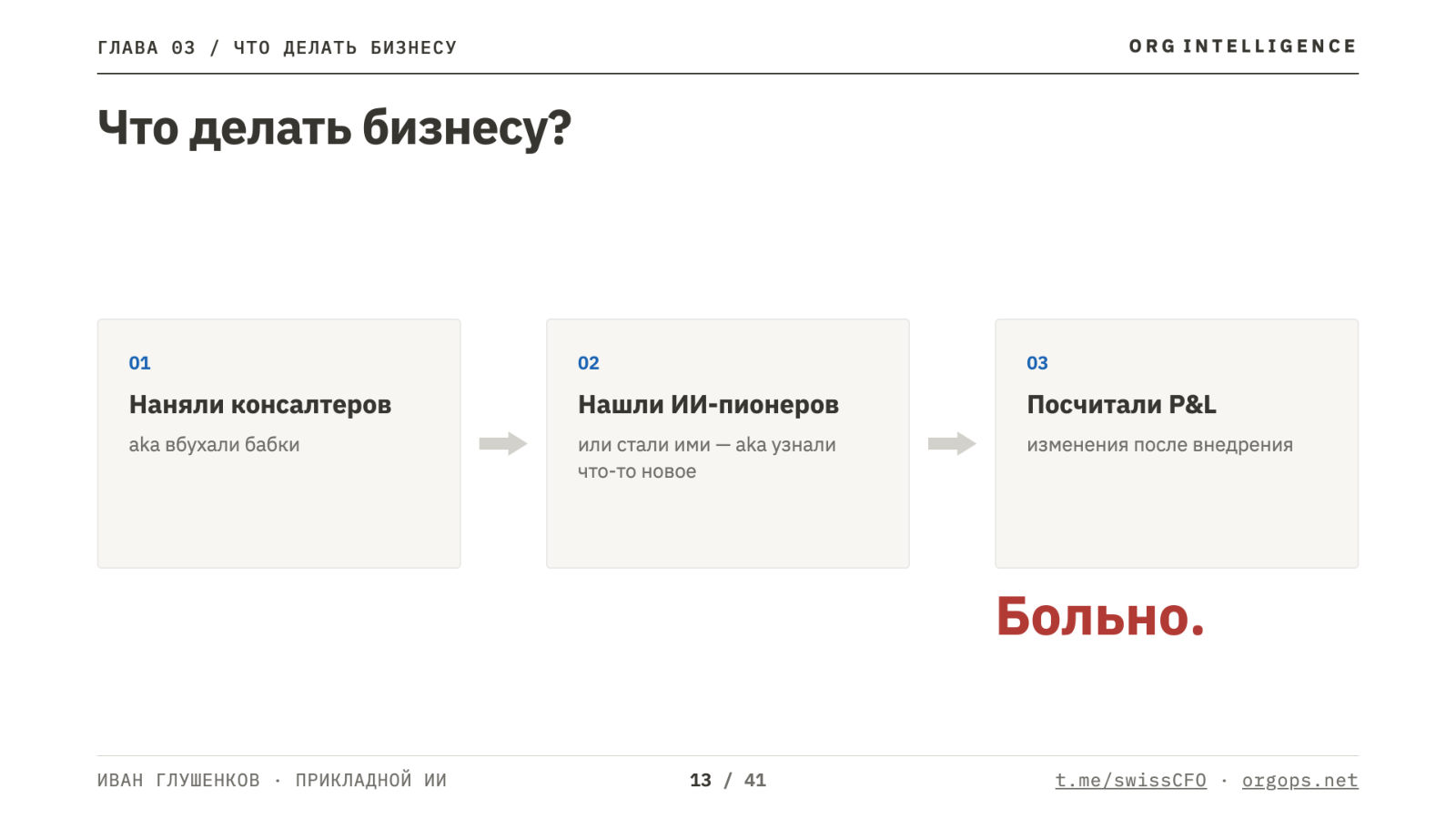
- 0:33 — "We'll throw money at it, hire consultants… find pioneers… work out the P&L, and it'll all be neat and tidy."
14. What a business should do: practice · ≈0:34–0:35
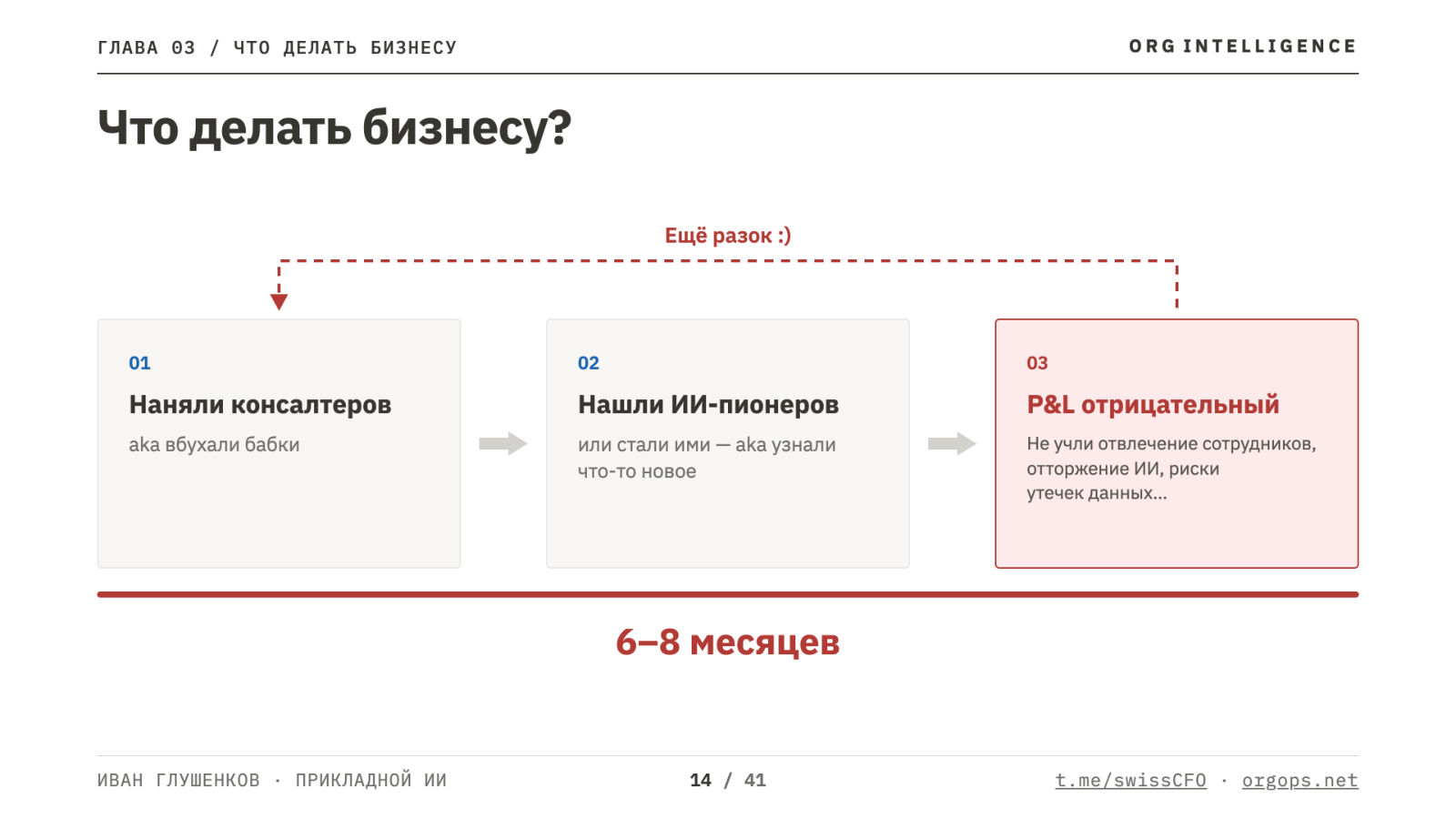
- 0:34 — Working out the P&L hurts: "what if it's negative… or goes against our political ambitions?" The distraction of people and security are left out. 6–8 months, expensive, and there may be no result.
- 0:35 — "I like not being the first one into a company… somebody has already sold them some crap."
15. What I advise · ≈0:35–0:36
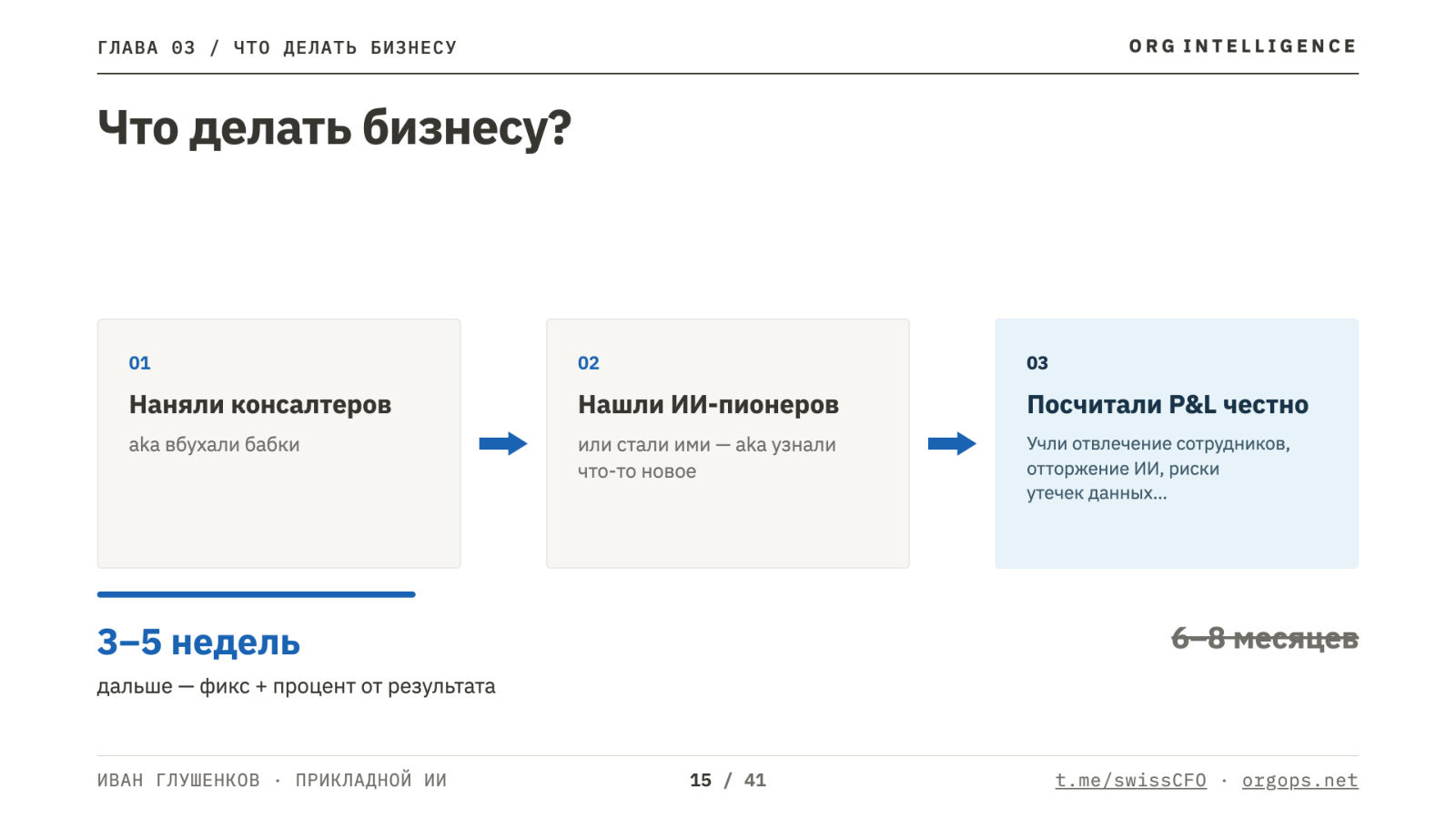
- 0:35 — Don't drag it out: run a fast test and see where the logic breaks. Work "for a small fixed fee and a percentage of the result."
Where the con is
16. The technology is ready, companies are not · ≈0:36–0:37
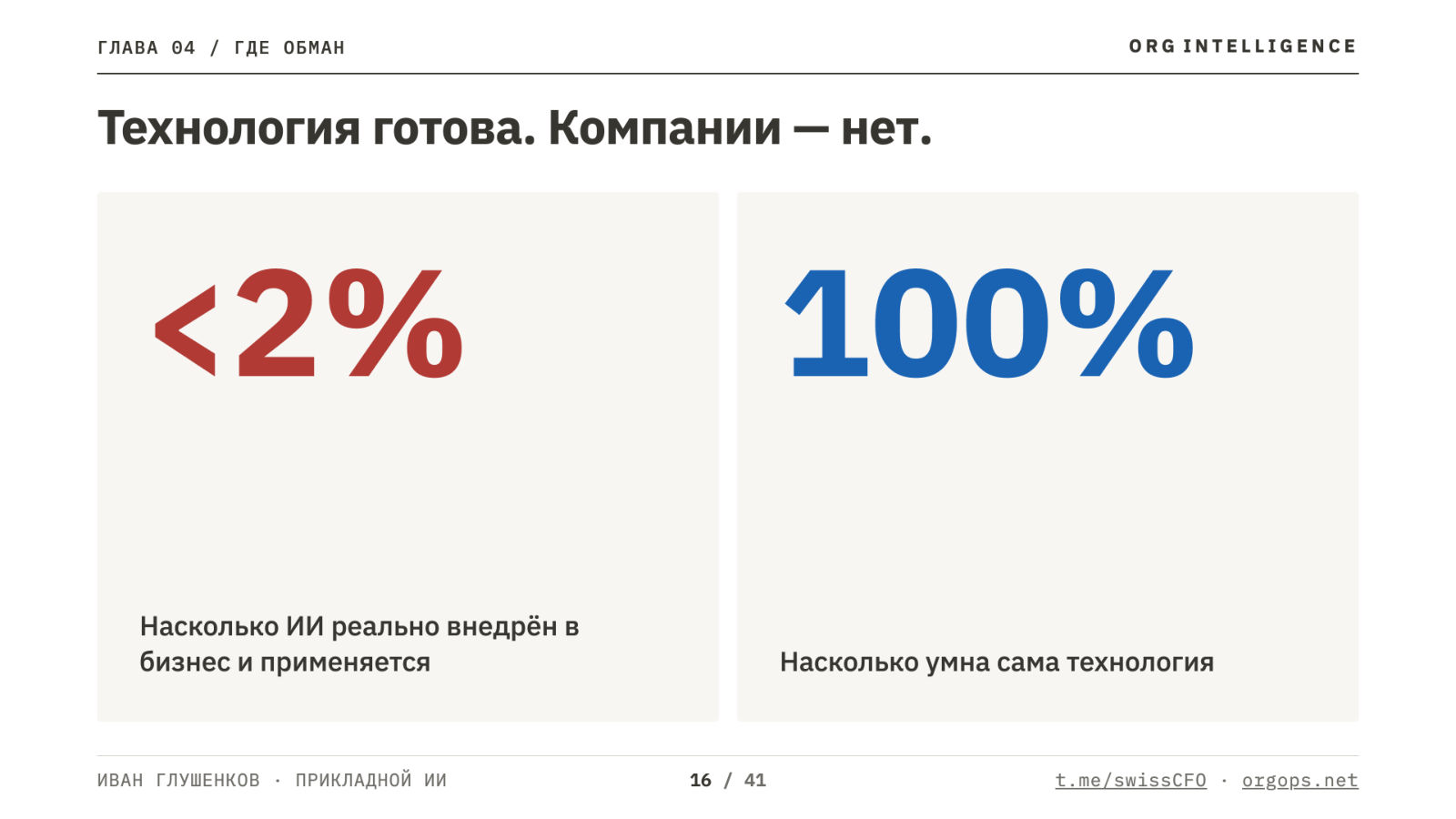
- 0:36 — "The technology is 100% smart… Next they'll be curing cancer with it." AI handles numbers 100%, communication "so-so," and it still can't make a decent presentation. The problem is that AI hasn't been implemented.
17. Where the con is · ≈0:37–0:38
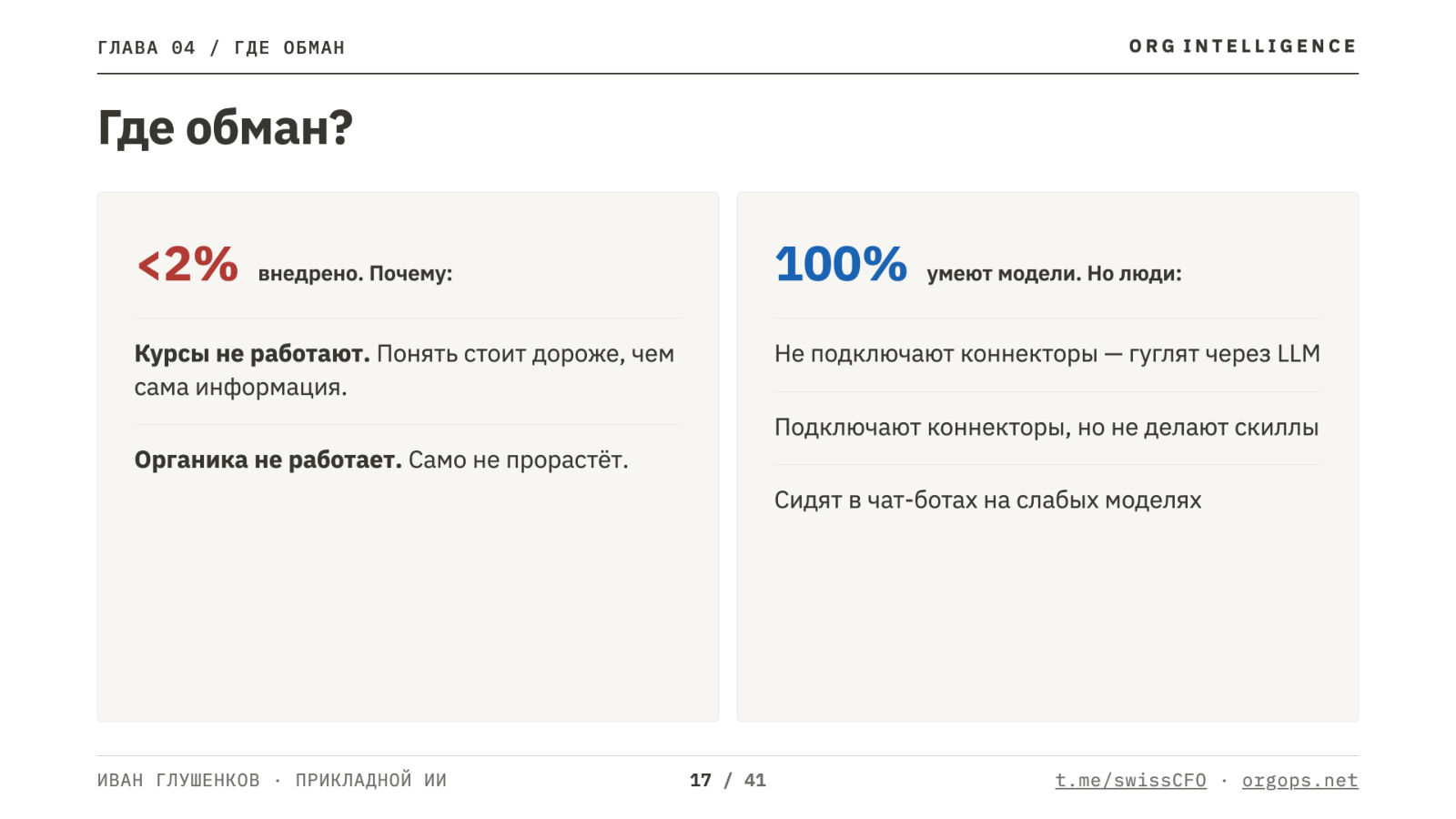
- 0:37 — "I bought every course I could find in Russian." You can take them, but "they'll overload your head, and you'll simply spend more of your time than your money."
18. Organic adoption · ≈0:38–0:41
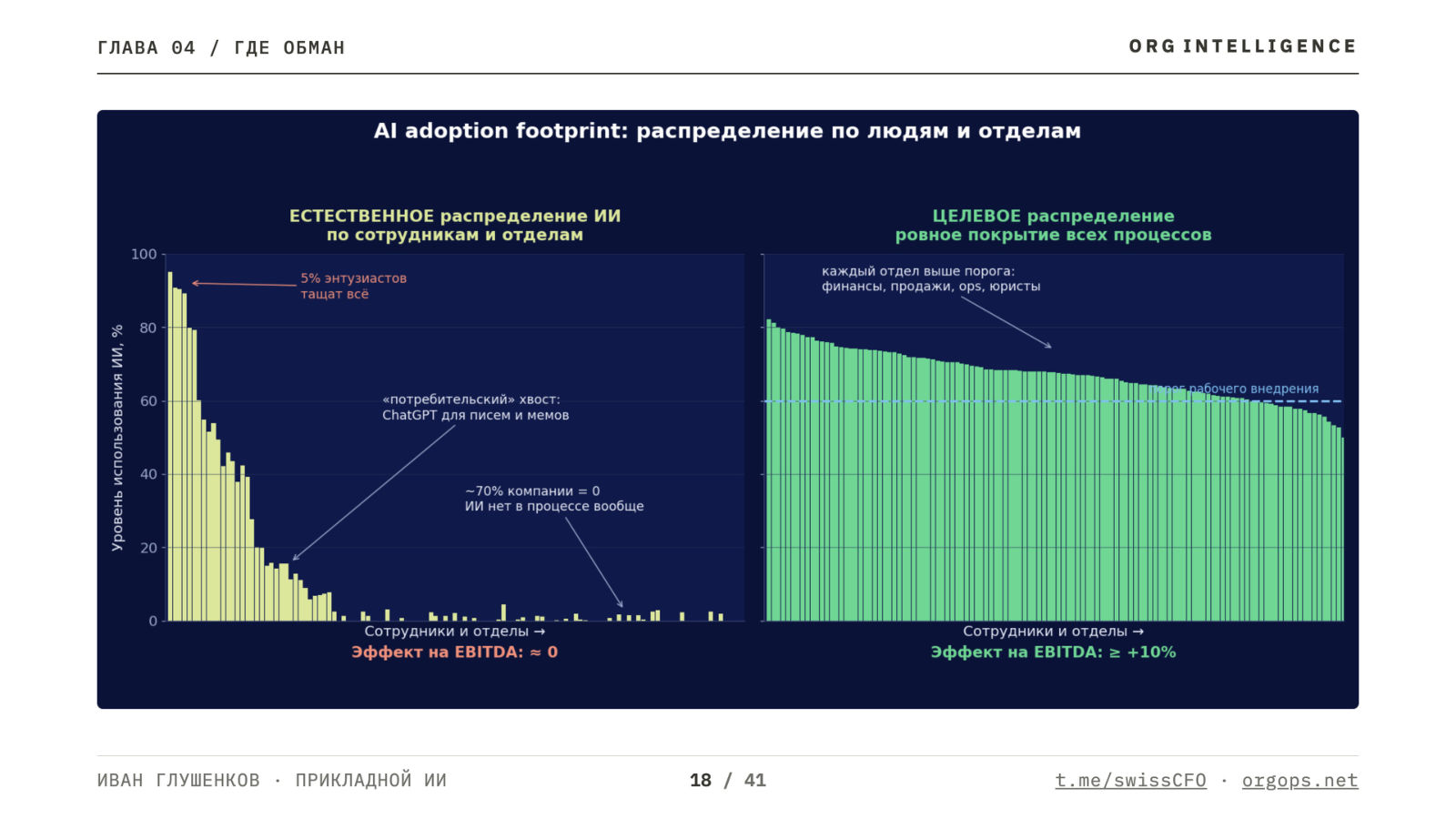
- 0:38 — 5% enthusiasts, and the rest fall off exponentially: +0–0.5% to EBITDA. For +10% ("that's just out of this world") you have to pull up the company's average level. That is the job of the C-level and the team leads, and for them it is rarely the top priority.
- 0:39 — Why AI seems dumb: a chat with no data, on a cheap subscription. "Guys who sold a company for $100+ million are sitting on an eight-dollar subscription." No connectors, no skills, an opinion a year out of date.
- 0:40 — The sound dropped out and was restored.
19. Who survived and thrived · ≈0:41–0:43
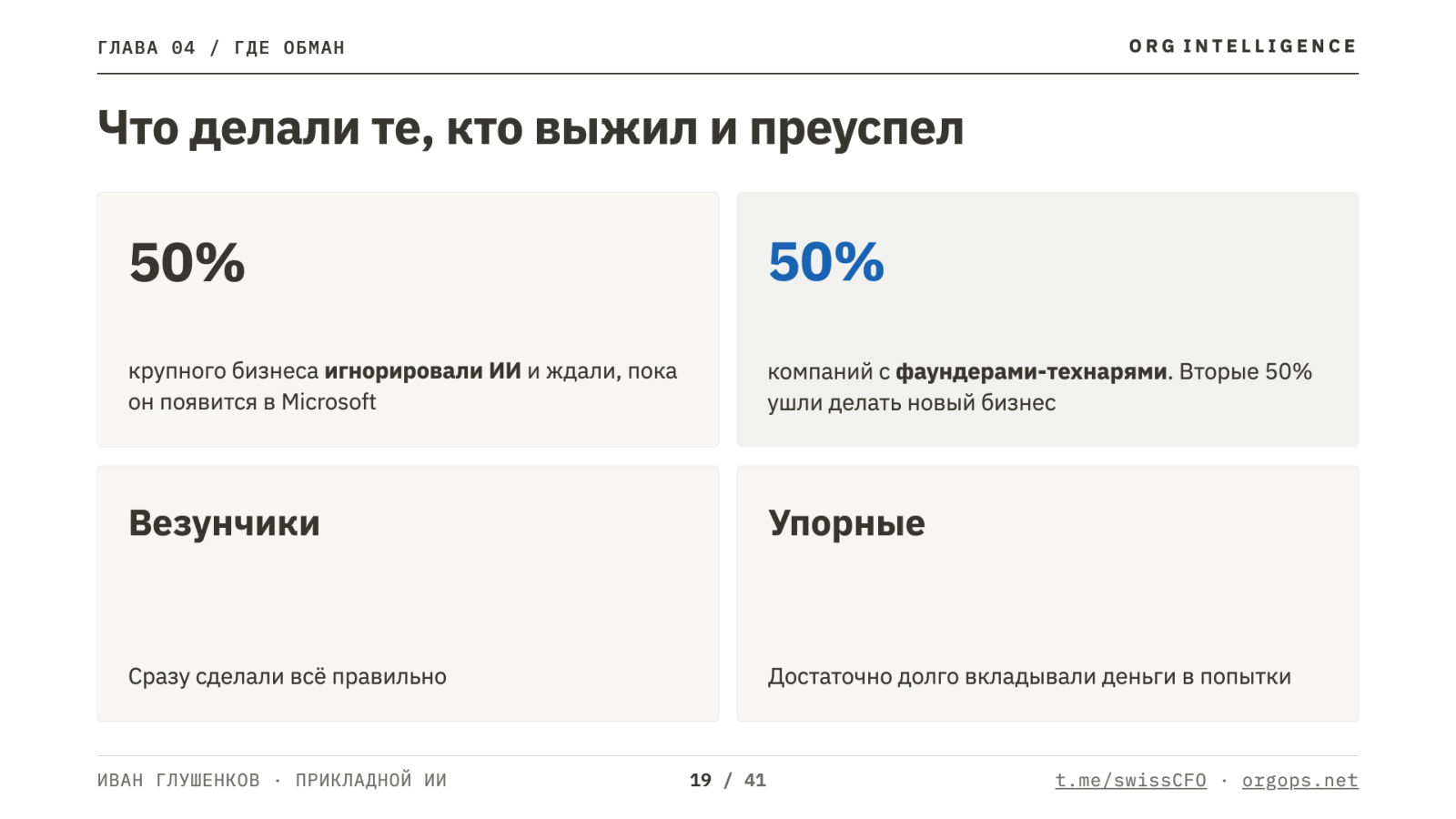
- 0:41 — Monopolies that could afford to ignore AI. Companies with a technical founder who managed to build AI in; Ivan often has to slow down "very fired-up founders."
- 0:42 — The lucky ones: "as a recommendation, it's like being born into a rich family." The persistent ones, who kept spending and learning.
20. What sells well · ≈0:43–0:44
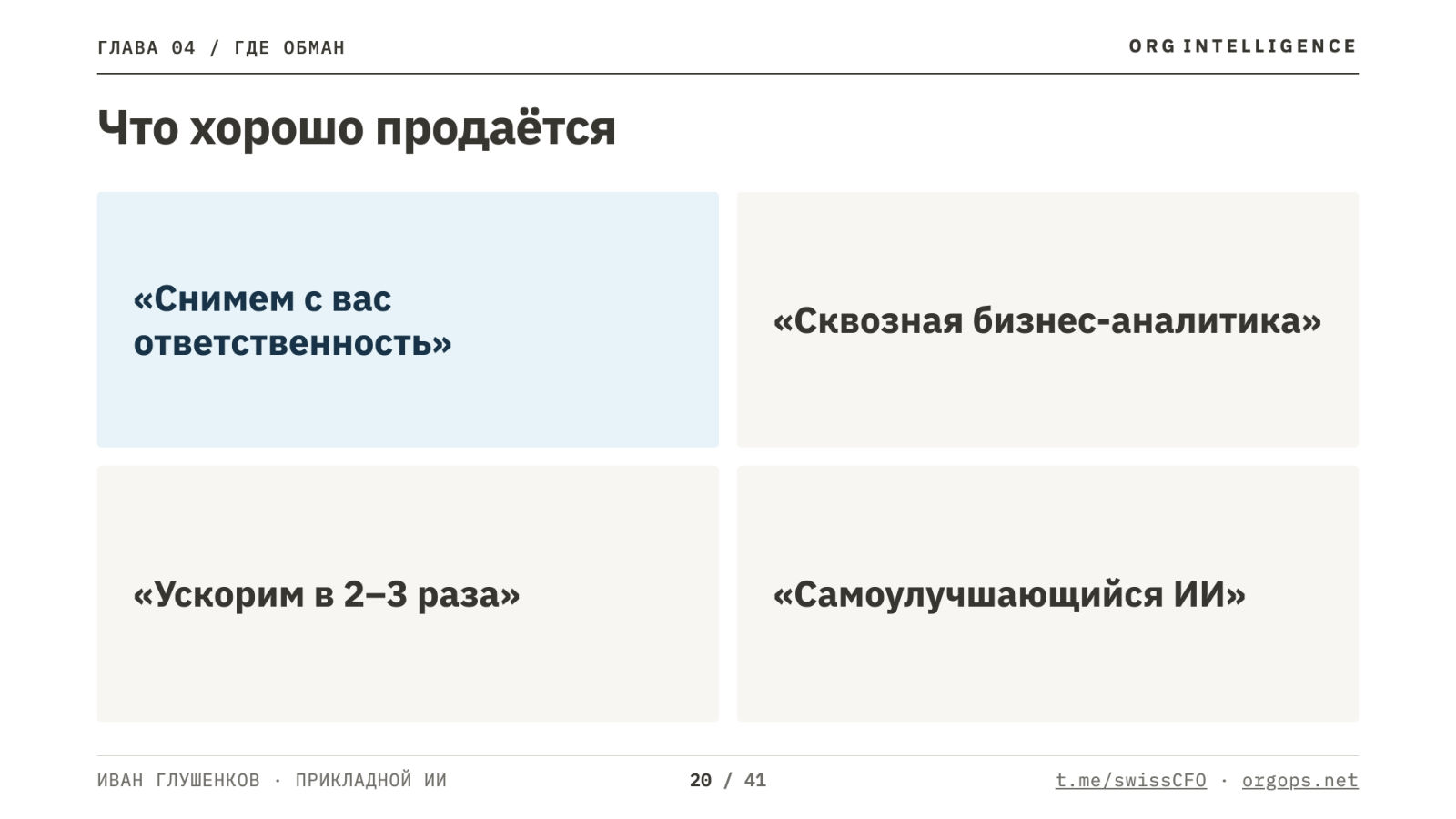
- 0:43 — "We'll take responsibility for implementing AI off your hands. The perfect offer." End-to-end business analytics: at Tesla, according to an acquaintance who is "Elon minus three," the internal AI is bad even with Cursor. A 2–3× speedup. "The company is on autopilot, and I sit there collecting dividends."
21. What actually happens · ≈0:44–0:47
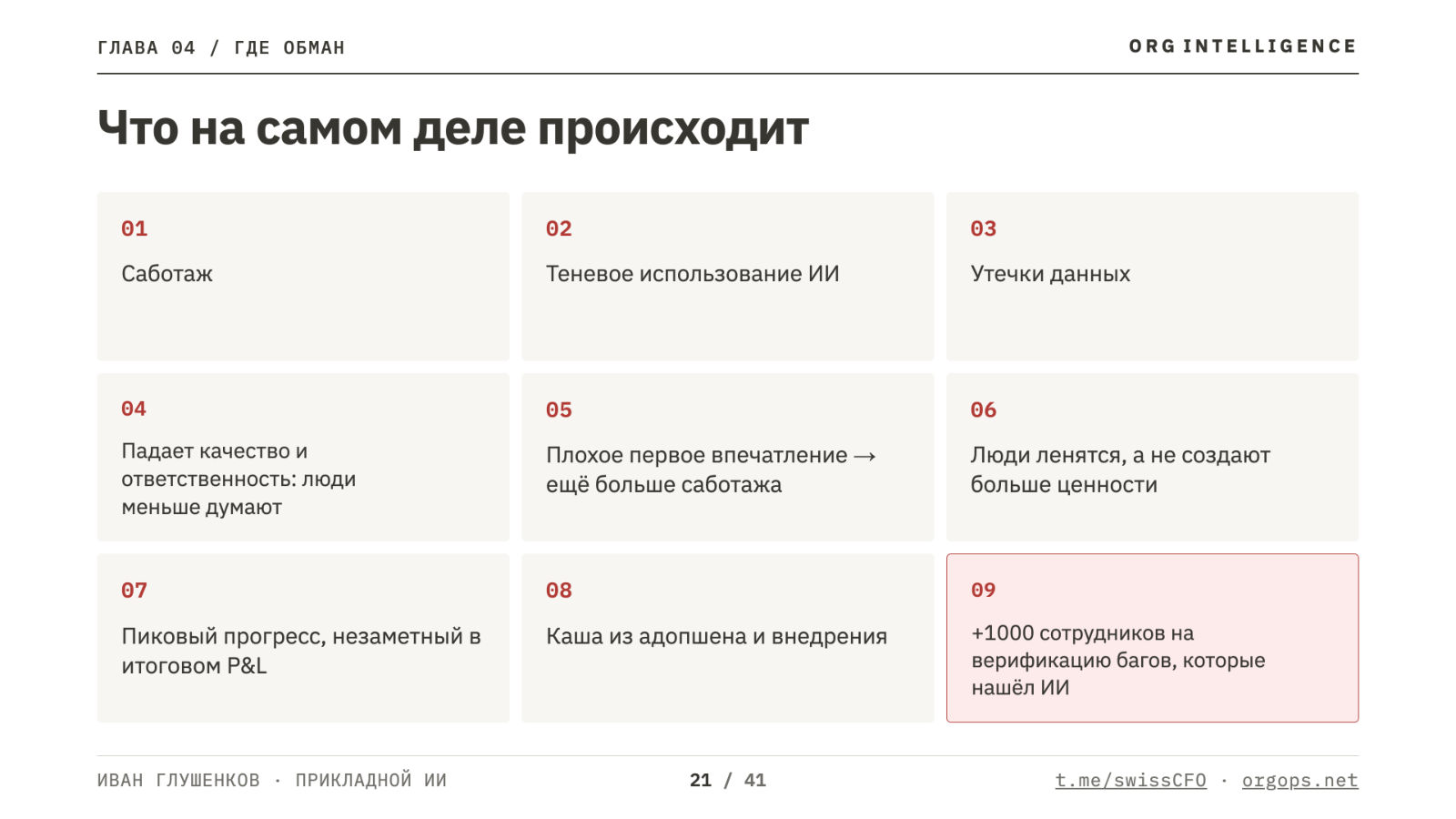
- 0:44 — Sabotage. Shadow use of personal subscriptions. Leaks "in some catastrophic volumes." "Ivan, you're our best friend… We work 2 hours a day now."
- 0:45 — A bad first impression means being ignored for 8–10 months. The "meat layer" between the boss and ChatGPT: "you're talking to ChatGPT in a human wrapper."
- 0:46 — "Adoption is purely about people, and implementation is about software." An American bank implemented AI, and it found so many bugs that they hired another thousand developers.
22. My own mistakes · ≈0:47–0:48
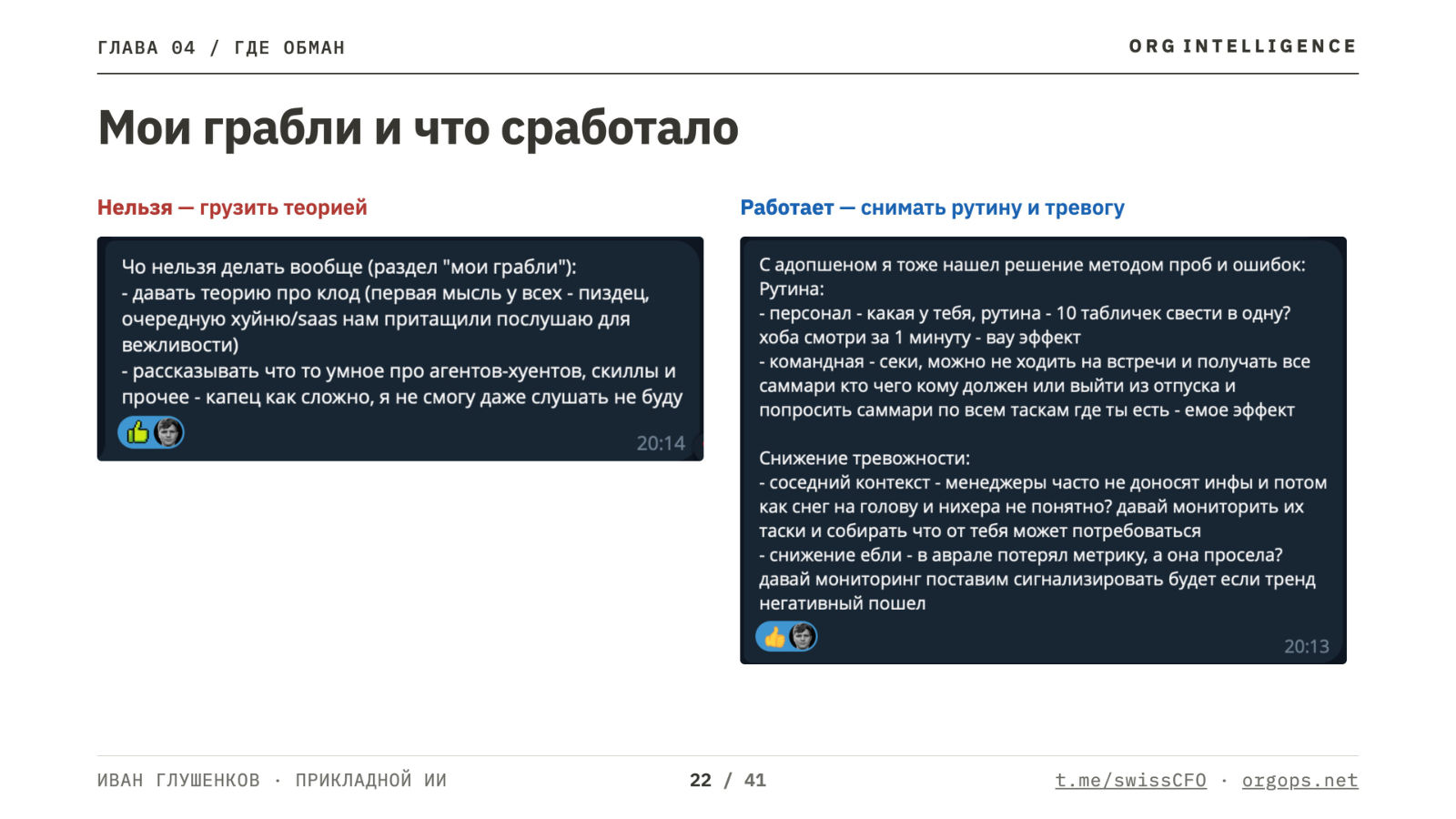
- 0:47 — "We found a great internal employee… let him do it all himself" — and it turns out "it's not all that simple." Theory and math don't work. What works is lowering anxiety, once information becomes available.
What people pay for
23. Product, distribution, margin · ≈0:48–0:52
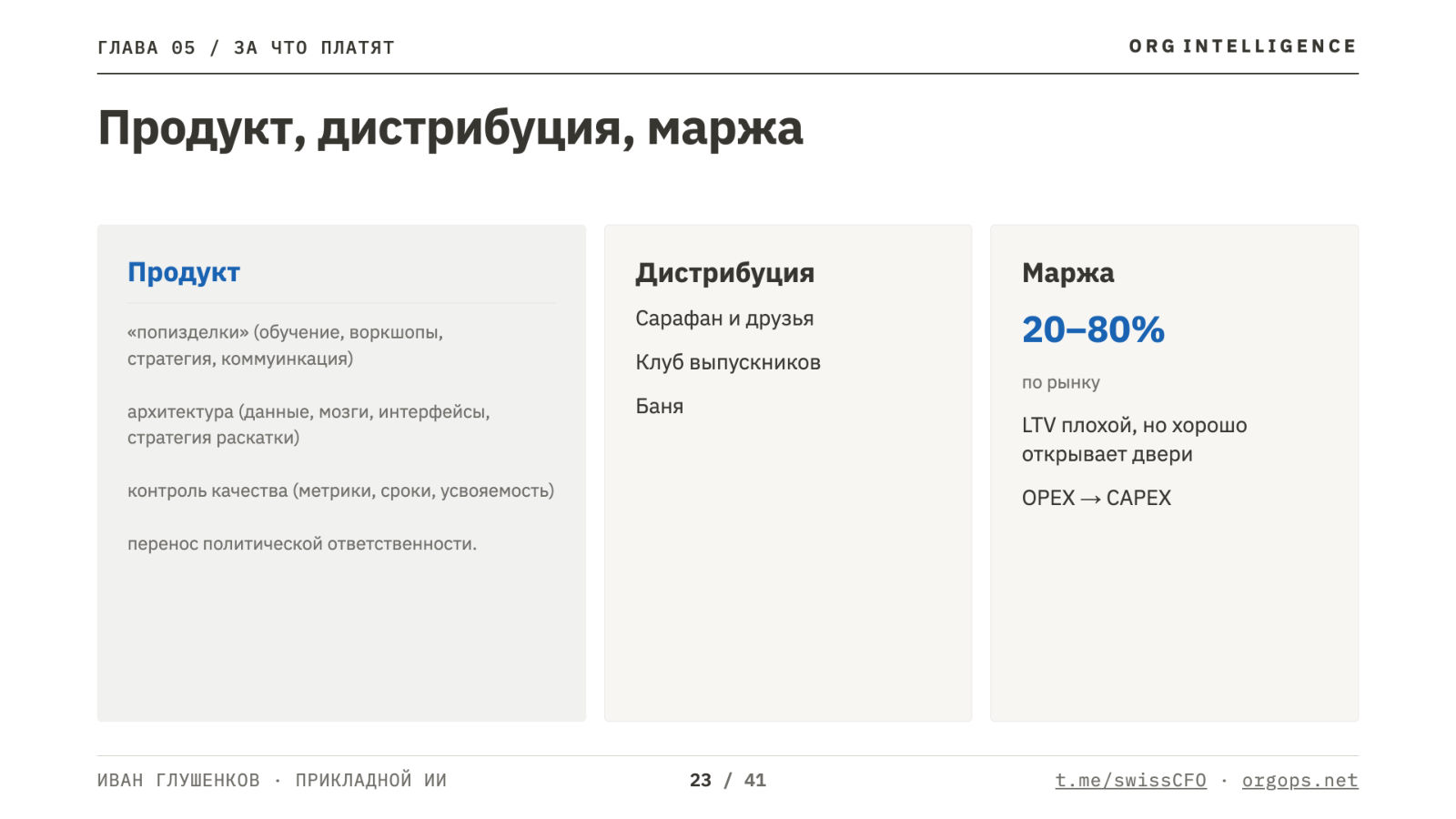
- 0:48 — What they buy: training and strategy ("that's where it all starts"), architecture (data, brains, human-in-the-loop, interfaces; a 300 MB Excel file usually doesn't need replacing), rollout strategy, control of quality and metrics.
- 0:49 — And a transfer of political responsibility: an IT department of 1,000 people and an AI team of 30 spent a year on cosmetics. You need an outsider who "couldn't be wrapped up in political games."
- 0:50 — Distribution is "word of mouth, friends… the alumni club, the banya." Margin 20–80%. LTV is "not great," but "AI is really good at opening doors." You put in opex, and the effect is "as if… you'd made a serious capex investment."
24. My funnel · ≈0:52–0:53
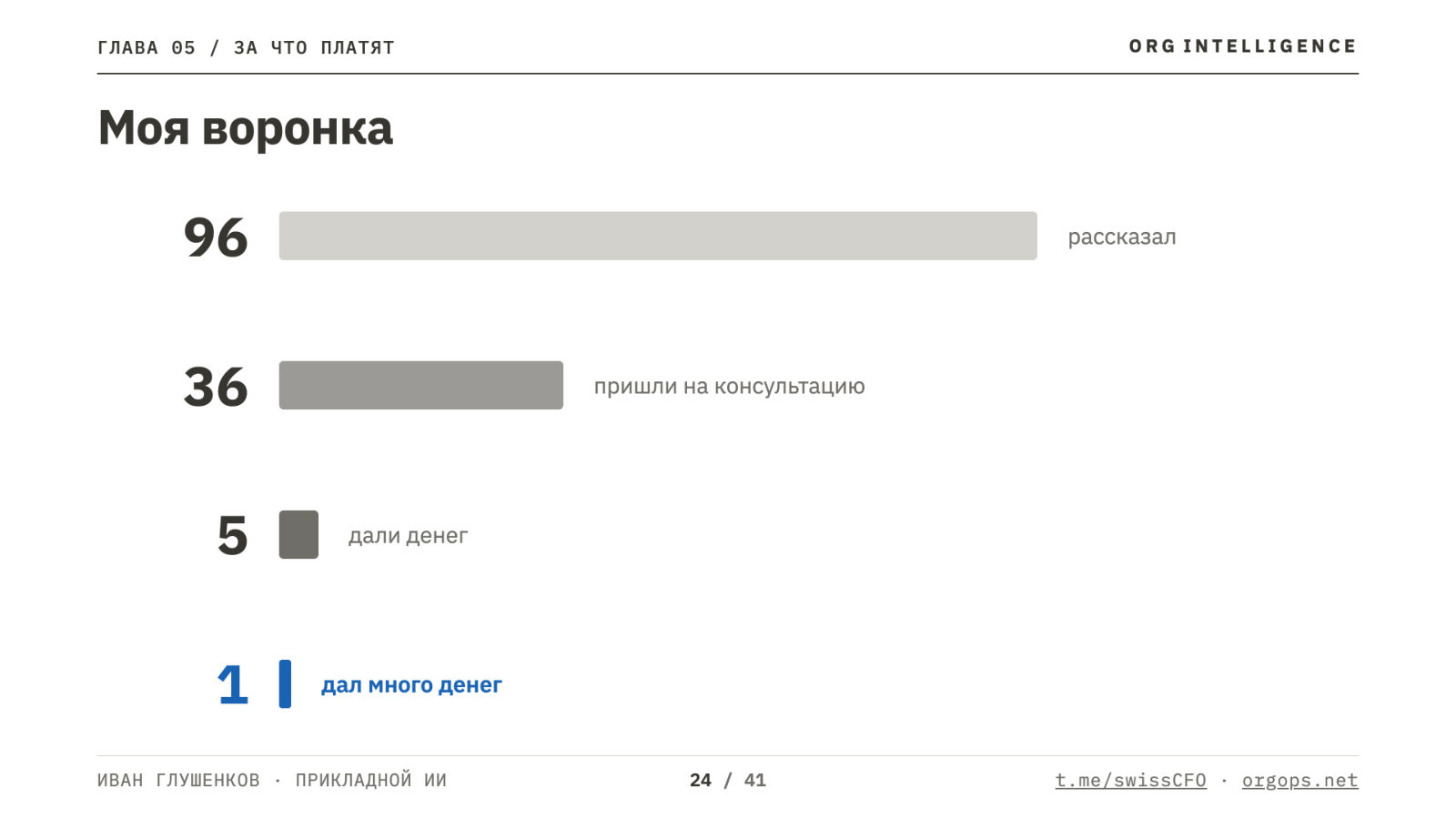
- 0:52 — He nearly died on a glacier in Zermatt, then got fired — and started telling everyone about AI: "it's a mission… I don't give a damn about the money." 96 got the link → 36 came for a conversation → 5 gave money, though he hadn't asked → 1 gave equity and invited him to build an AI-native bank.
25. A bad presentation and a good one · ≈0:53–0:55
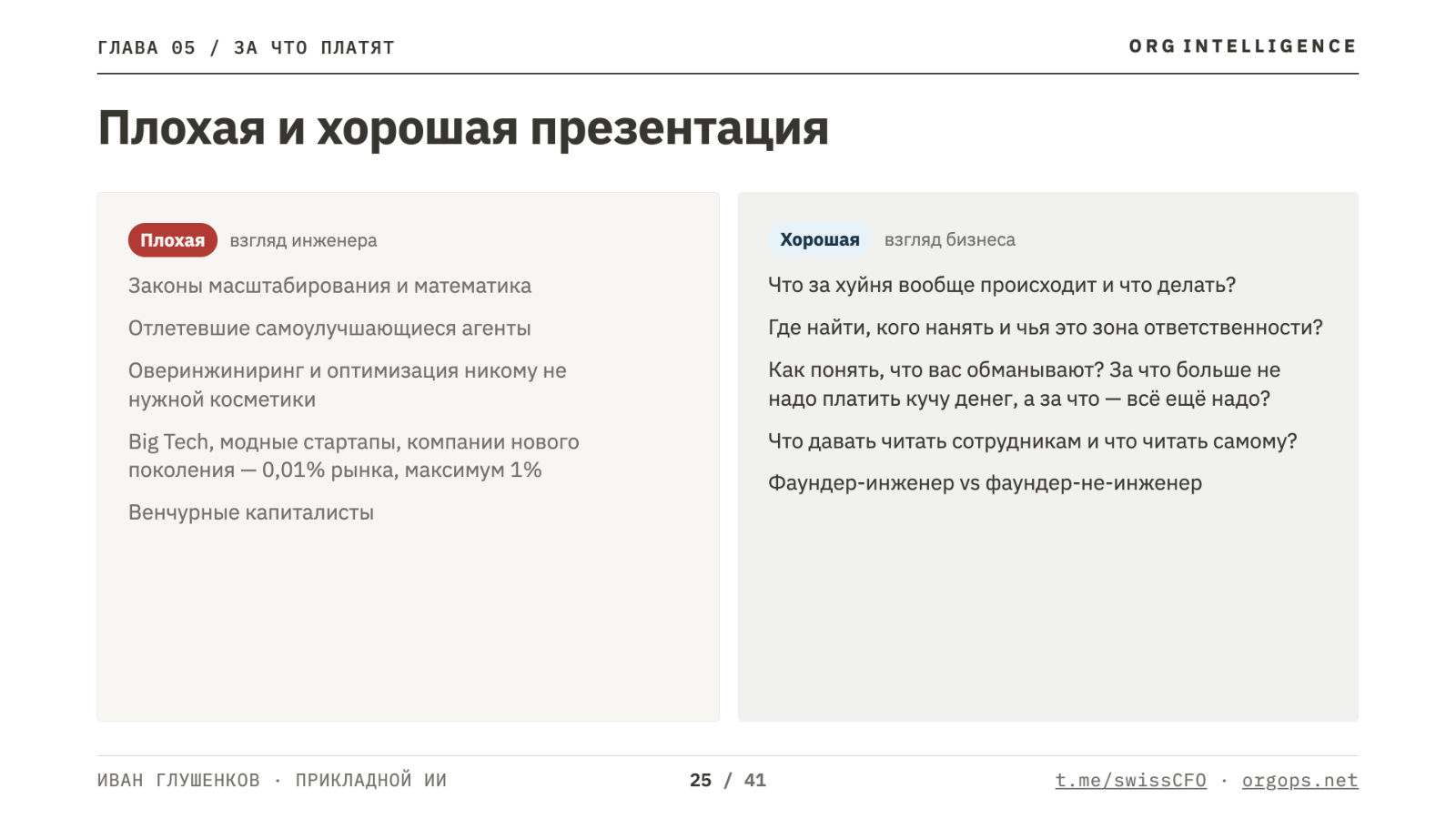
- 0:53 — A bad one is "about math, about scaling laws… everything engineers adore." A good one answers the business: what is happening, whom to hire, how much to pay, "how to tell that we're already being screwed."
How to implement
26. What stage you are at · ≈0:55–0:56
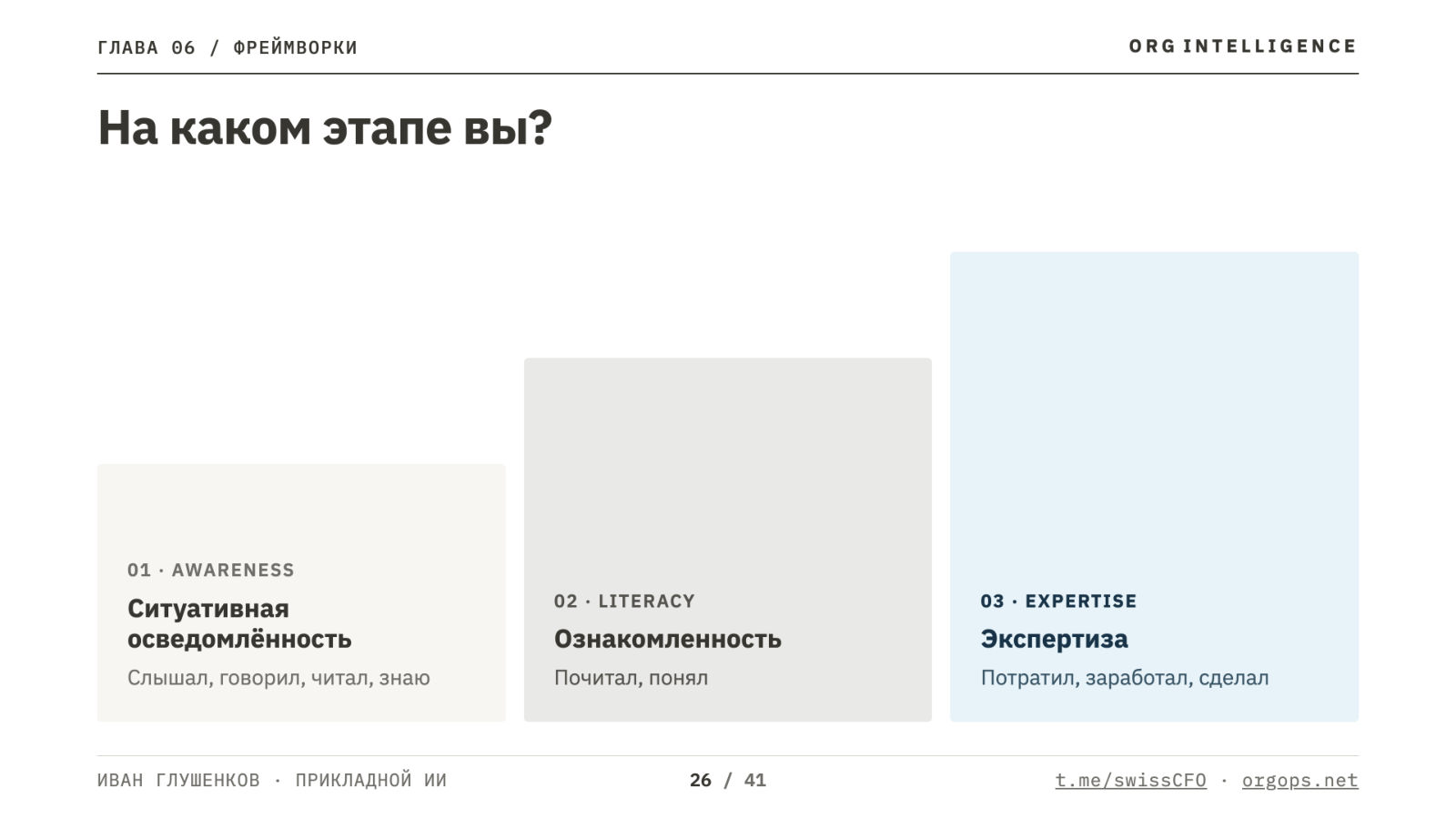
- 0:55 — Awareness → Literacy → Expertise. Heard about it → went to read and try → started spending the company's money and resources.
27. What engineers should do · ≈0:56–0:58
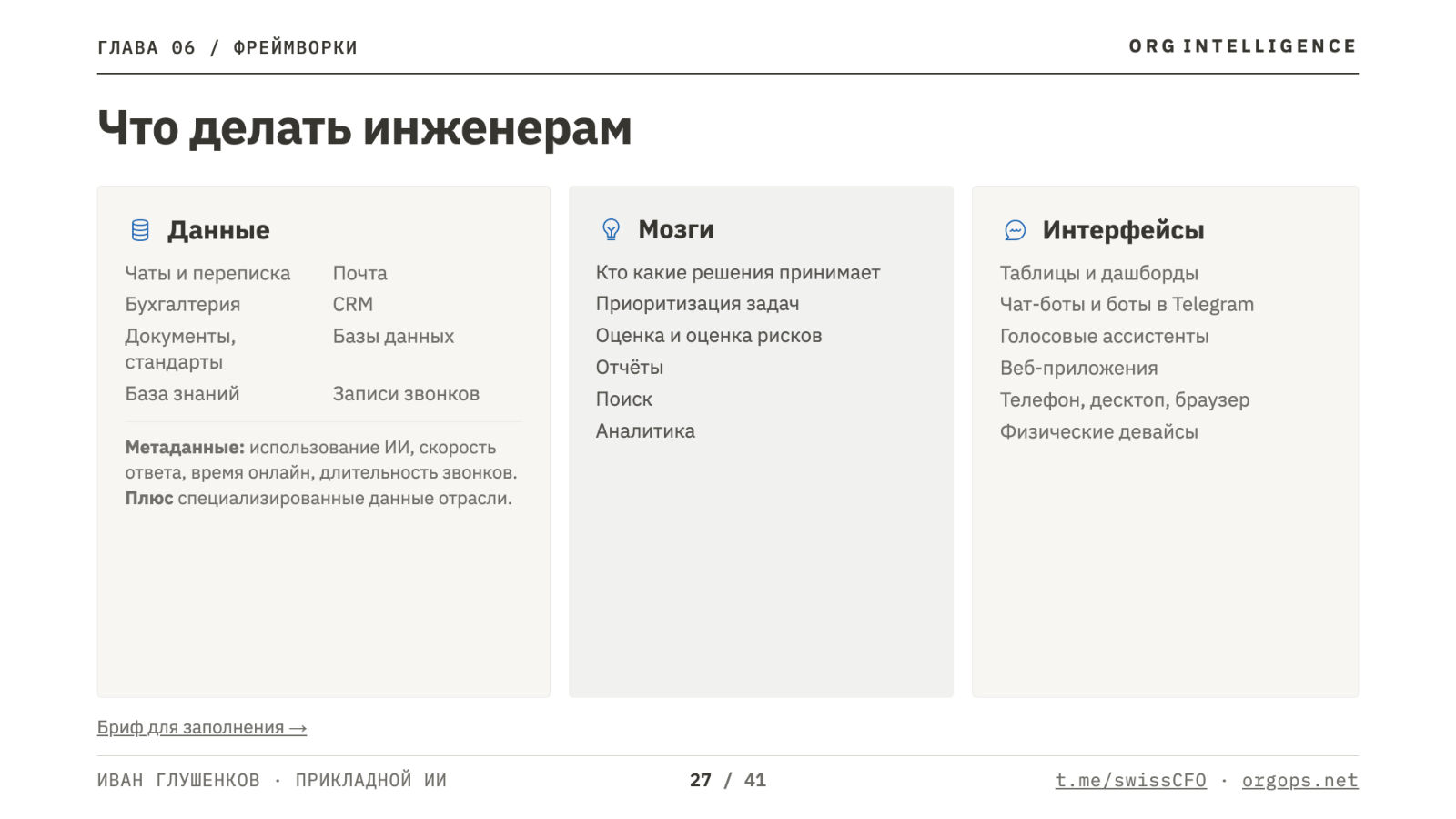
- 0:56 — "Any company, any person, any role, any department is data, brains and interface. They need to be separated." Inside Claude they are mixed together, which is bad practice. Touch the interface with care: people are used to it. The link to the brief is on the slide.
- 0:57 — Data: chats, email, accounting, calls, metadata on AI usage ("an ultra-valuable thing"). Brains: who makes decisions and how. Interface: Excel, dashboards, bots. "Most C-levels… work on an iPad, and Claude doesn't work on an iPad at all."
28. After implementation · ≈0:58–0:59
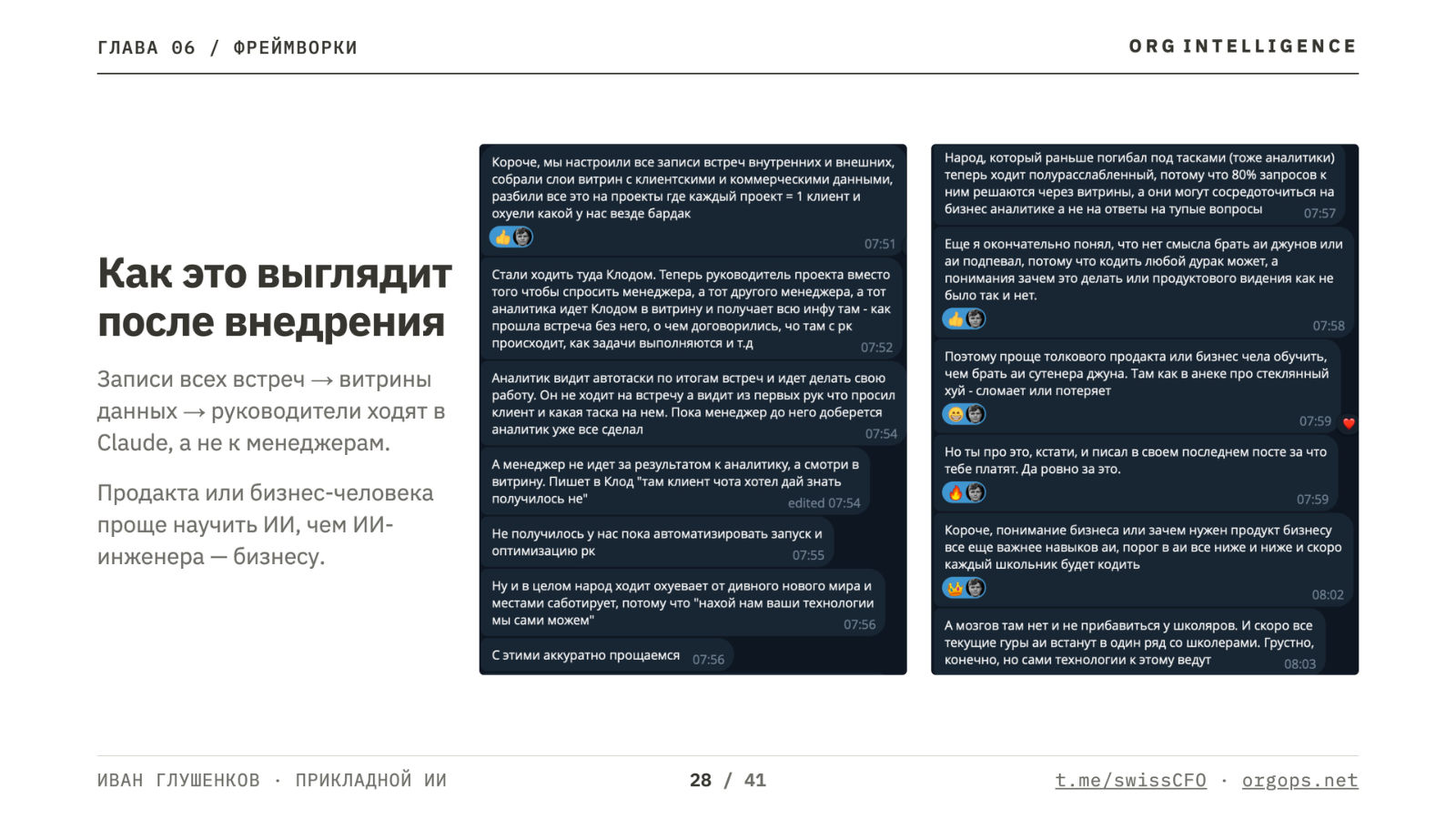
- 0:58 — The slide shows the "honest emotions" of owners and C-levels, taken from their messages; they weren't read aloud.
29. How to prepare for layoffs · ≈0:59–1:01
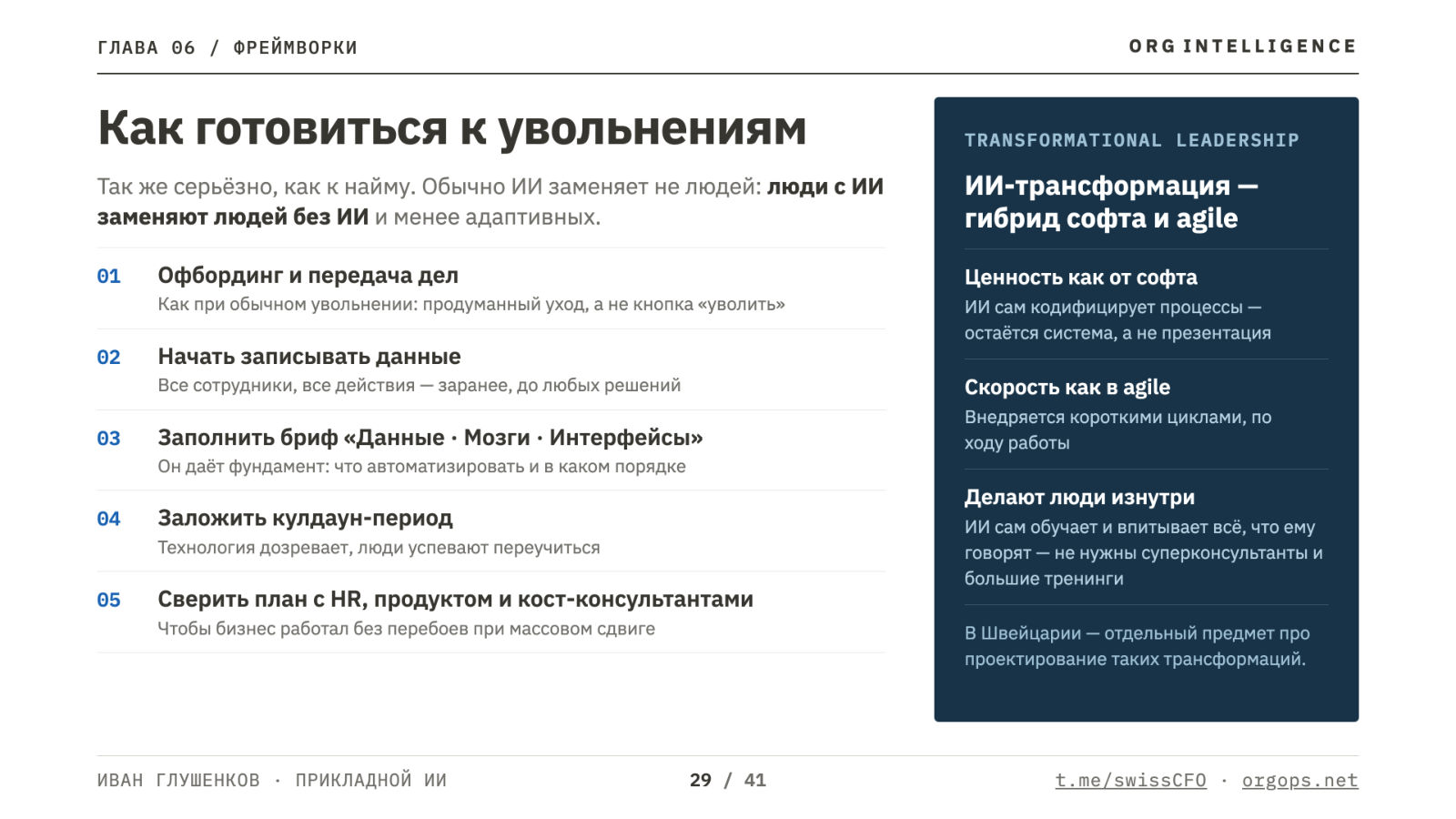
- 0:59 — A layoff plan is like a hiring plan: onboarding, offboarding, data capture, cooldown. Then lay off those "who are guaranteed to be no longer needed." Fill in the brief and check it against HR, product and cost consultants.
- 1:00 — AI is both code (capex, your own IP) and a soft methodology like agile. Plus engagement: "people start talking through everything that hurts, and you can watch it happen."
Whom to hire
30. Whom to hire and who else is out there · ≈1:01–1:05
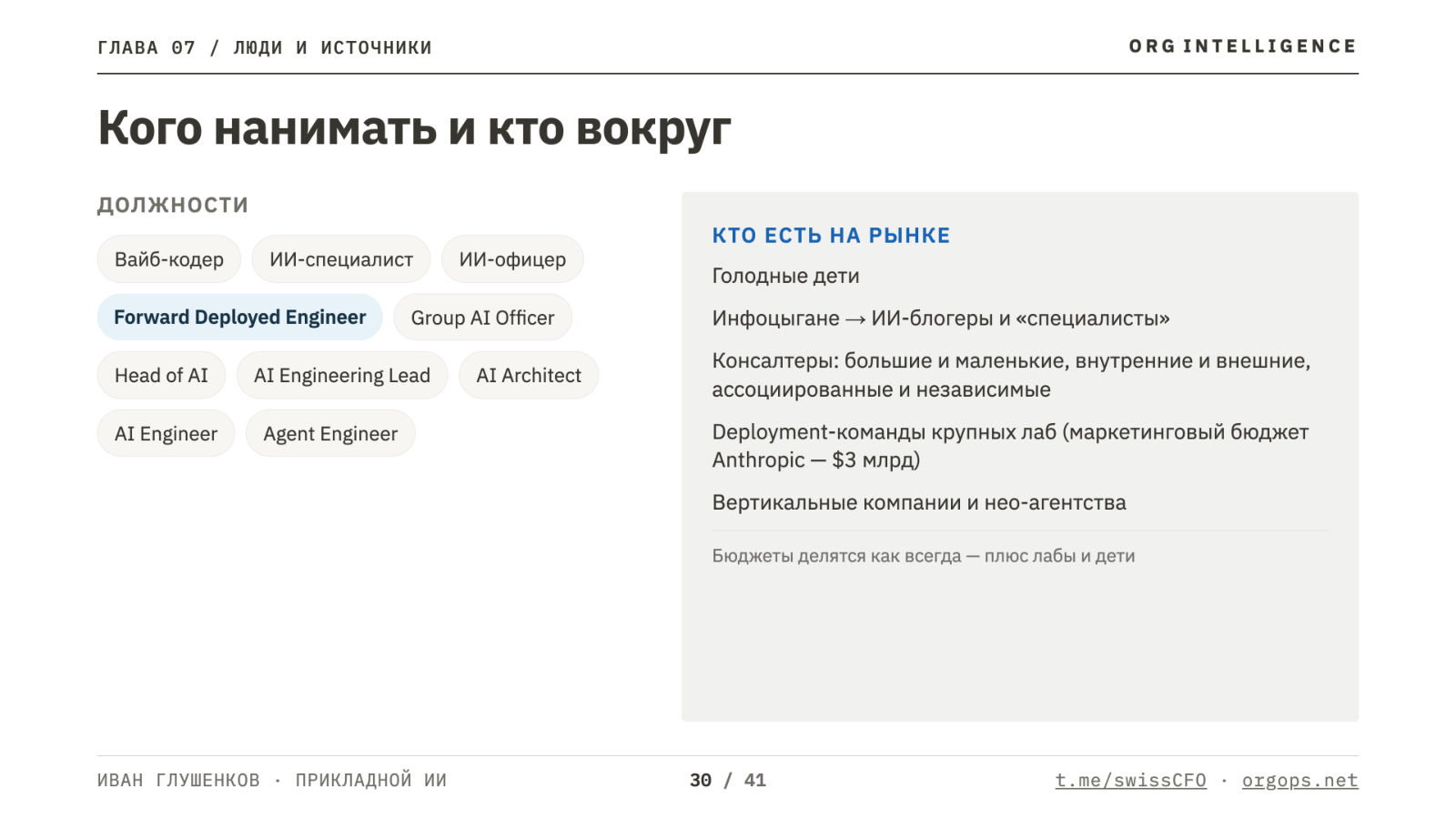
- 1:01 — Vibe coder, AI specialist, Forward Deployed Engineer, Group AI Officer, Head of AI, AI Architect, Agent Engineer. Individuals cost €5–10k a month, agencies €15–25k.
- 1:02 — In America it is all institutionalized. In Europe they look at you "like a baboon speaking an incomprehensible language."
- 1:03 — The Big 4 and McKinsey ("for the first two years… they earned more than anyone"), IBM's consulting arm, course-selling gurus, the labs' own teams (Anthropic has "a $3 billion marketing budget… B2B"), "hungry kids." Corporations sometimes turn you down: "too small… or a Russian passport."
- 1:05 — A short break for a club announcement. Ivan: "2026 is the most important year in the history of human civilization."
31. Where the information comes from · ≈1:05–1:09
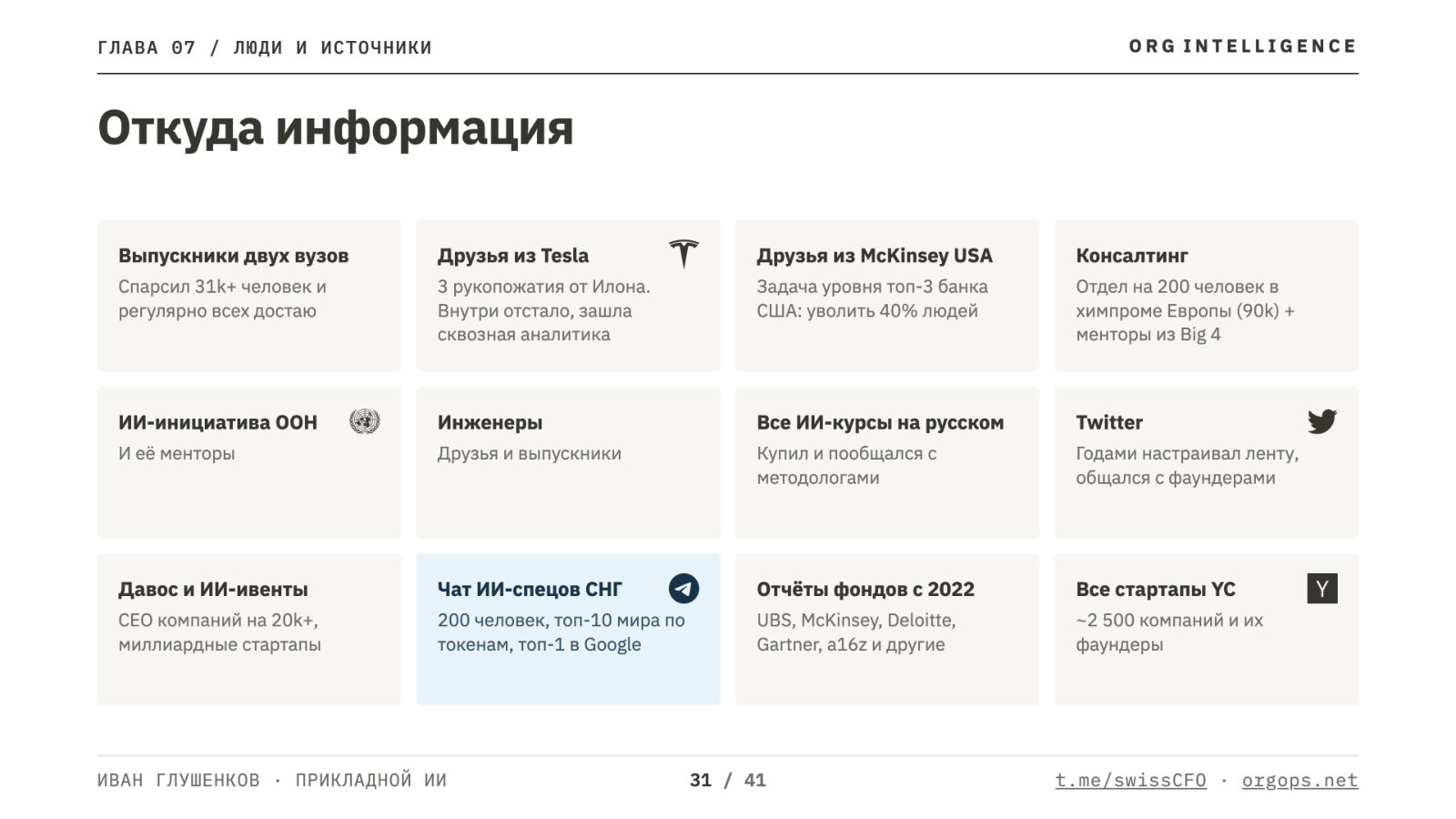
- 1:06 — Alumni of MIPT and of a Swiss university, friends at Tesla and McKinsey USA ("a bank the size of the US top 3 is trying to lay off 40% of its people"), the chemical plant, a UN initiative in Zurich.
- 1:07 — Every course. His feed on X: "this business model… I stole it from America," where they charge from $10 million. Davos. A private chat of AI specialists from the CIS.
- 1:08 — Reports going back to 2016 ("all of December… under the Christmas tree"). All 2,500 YC companies and their investment theses: "reading live market data on where the money is being poured."
32. Limitations · ≈1:09–1:10
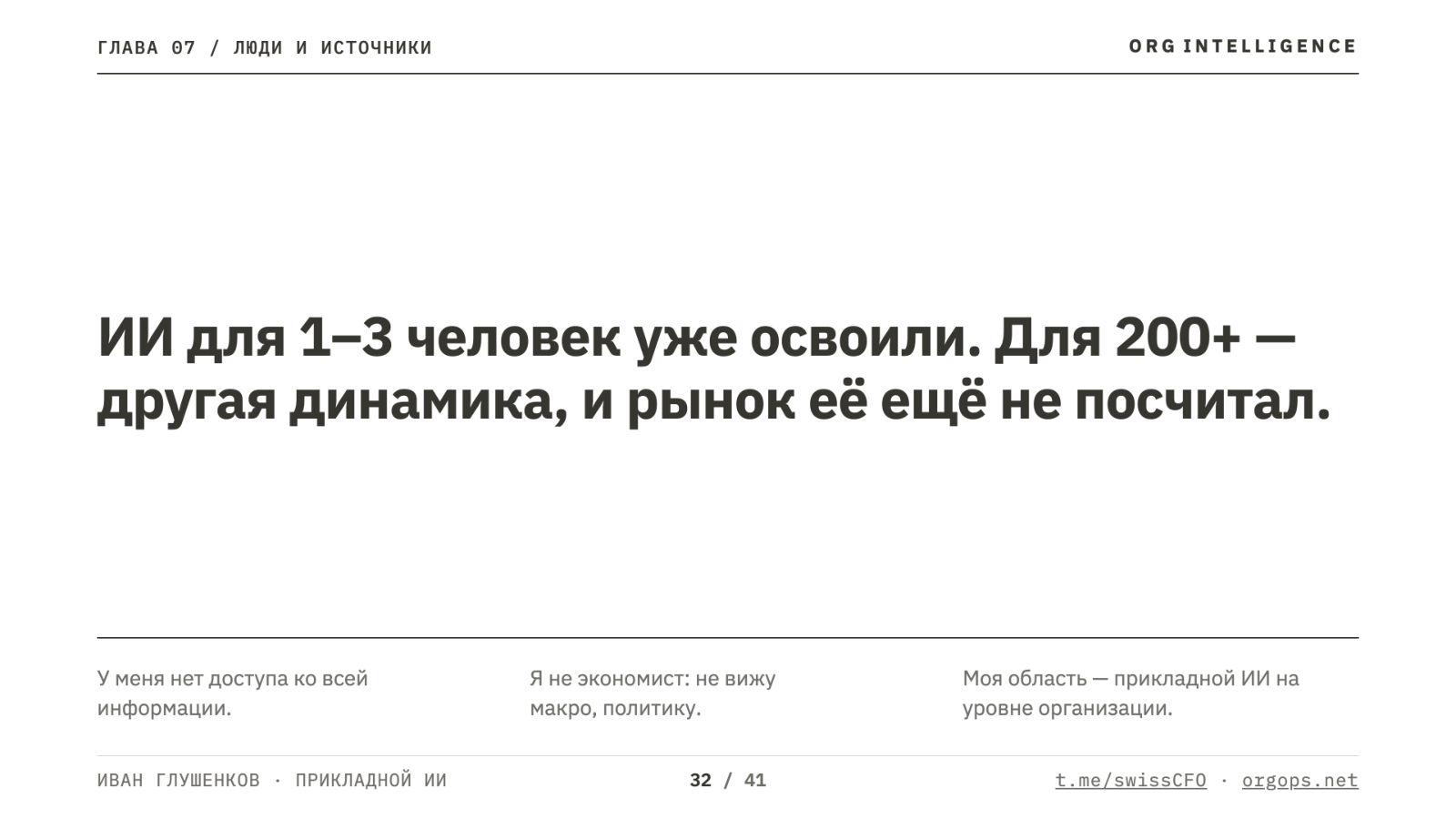
- 1:09 — AI for 1–3 people is well understood; for companies of 200 people and up the dynamics are unclear, and that is the game Ivan plays. "I'm not an economist… I came into all this off the street, so to speak."
33. Principles and what people pay for · ≈1:10–1:12
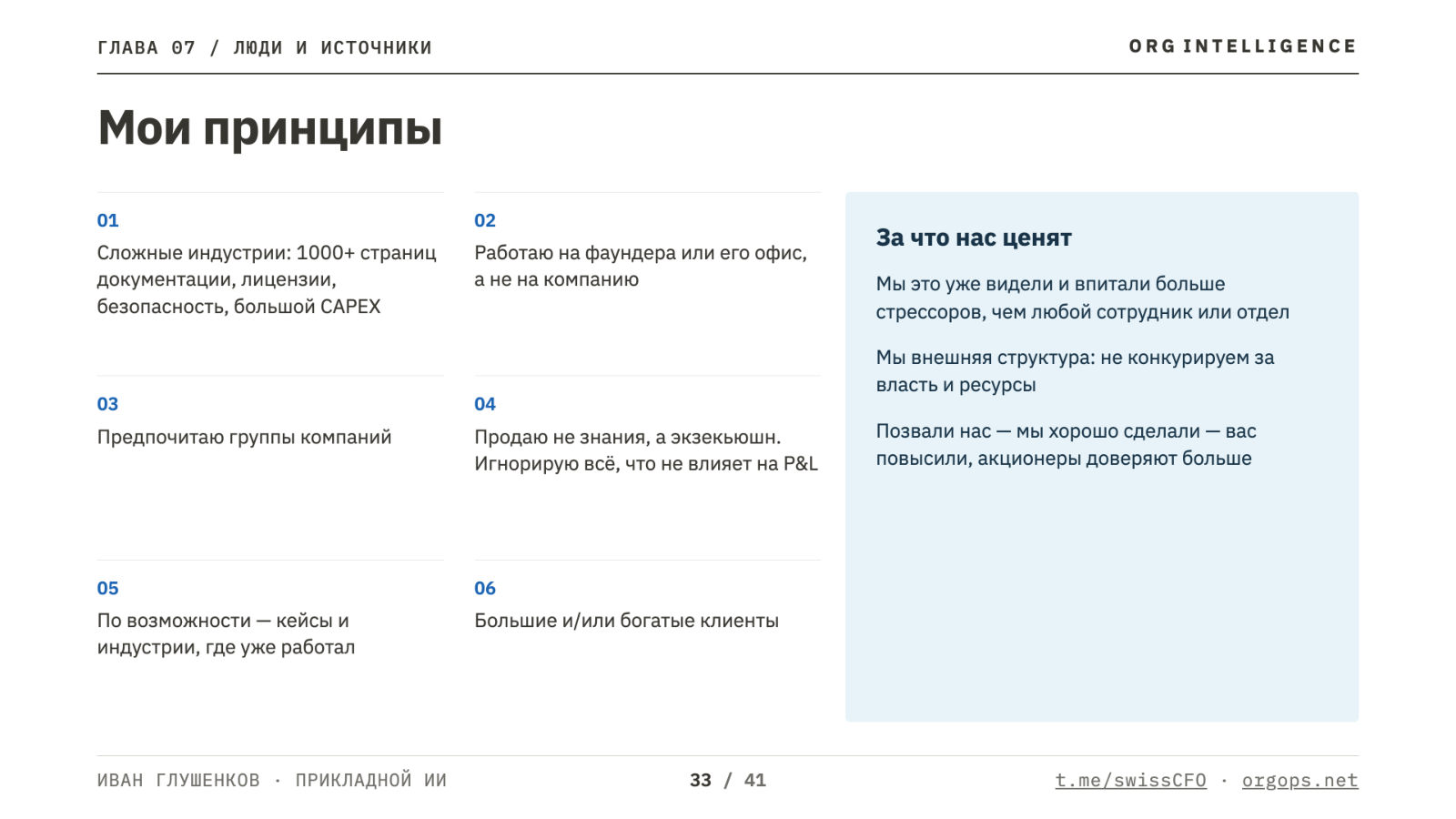
- 1:10 — Complex industries: 1,000+ pages, licenses, capex — "the hungry kids won't make it that far." Working for the founder, for groups of companies. Execution is what gets sold; knowledge is free. Only what affects the P&L. "Try not to get creative." Wealthy clients.
- 1:11 — "We've usually seen and absorbed more stressors than any employee." External, not competing for power or budget, always with a KPI. Whoever brought them in gets the political credit.
Conclusions
34. Moore's law for professions · ≈1:12–1:13
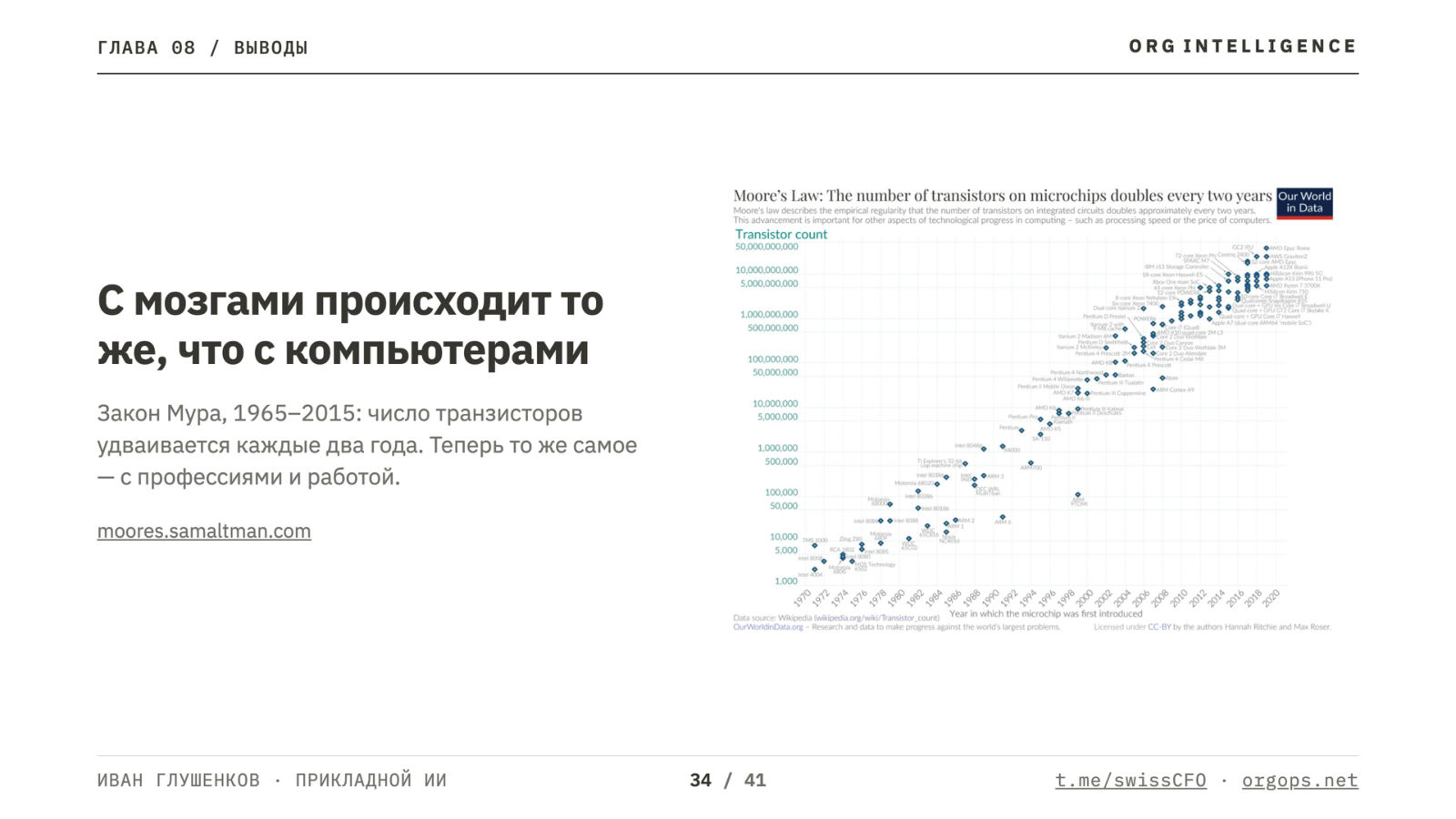
- 1:12 — "The same thing is happening to brains now as happened to computers." Every 6–8 months, any economically significant work becomes 2–10 times cheaper through AI.
35. What to take away · ≈1:13–1:14
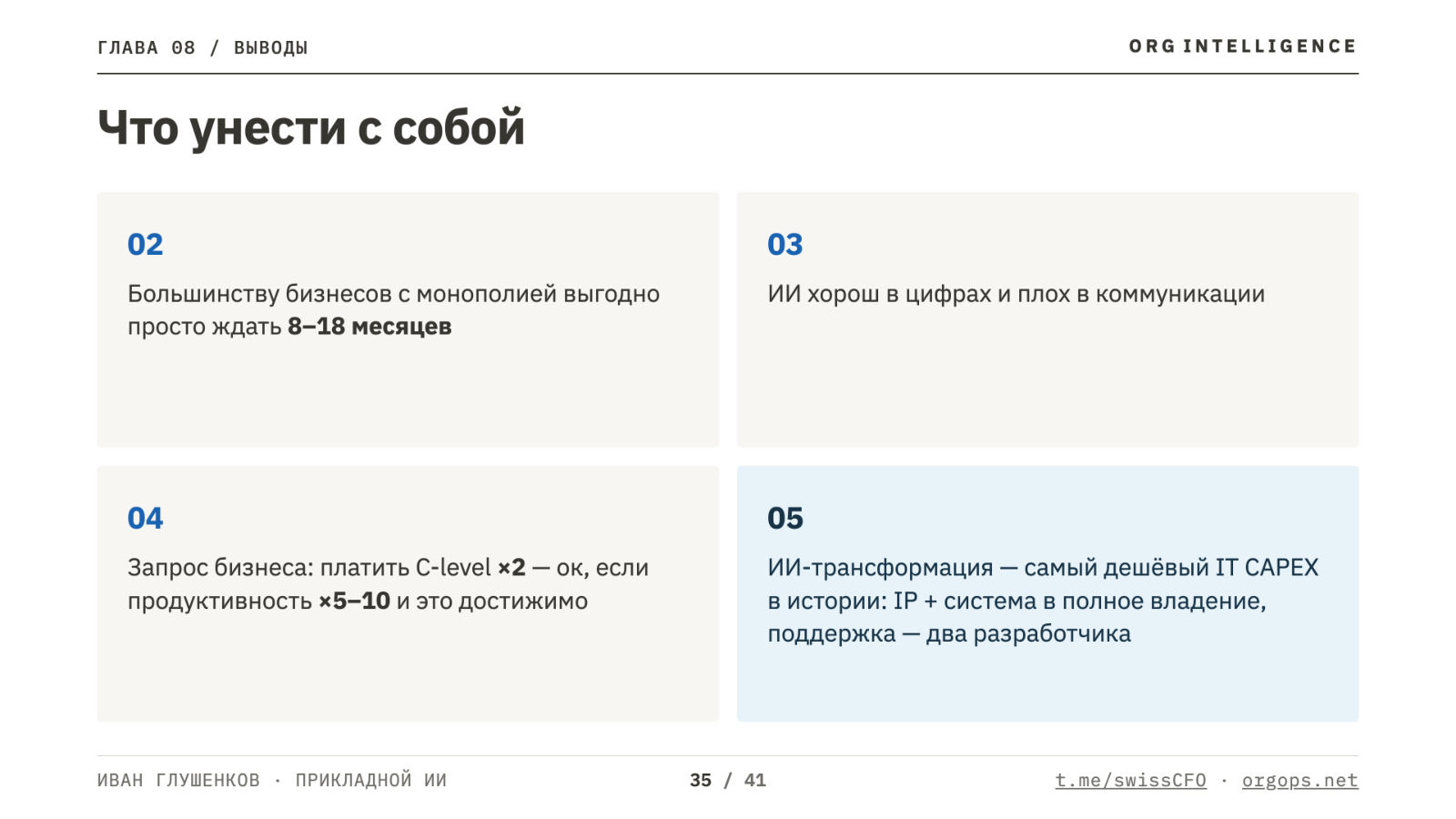
- 1:13 — Monopolies are better off waiting: "don't sweat it." AI is "good with numbers and bad at communication." A C-level with 20 finance people is ready to pay €20–30k if, with 1–2 engineers, he can do the department's work: "And that's achievable." AI transformation is "the cheapest IT capex in history."
36. Companies aren't helpless · ≈1:14
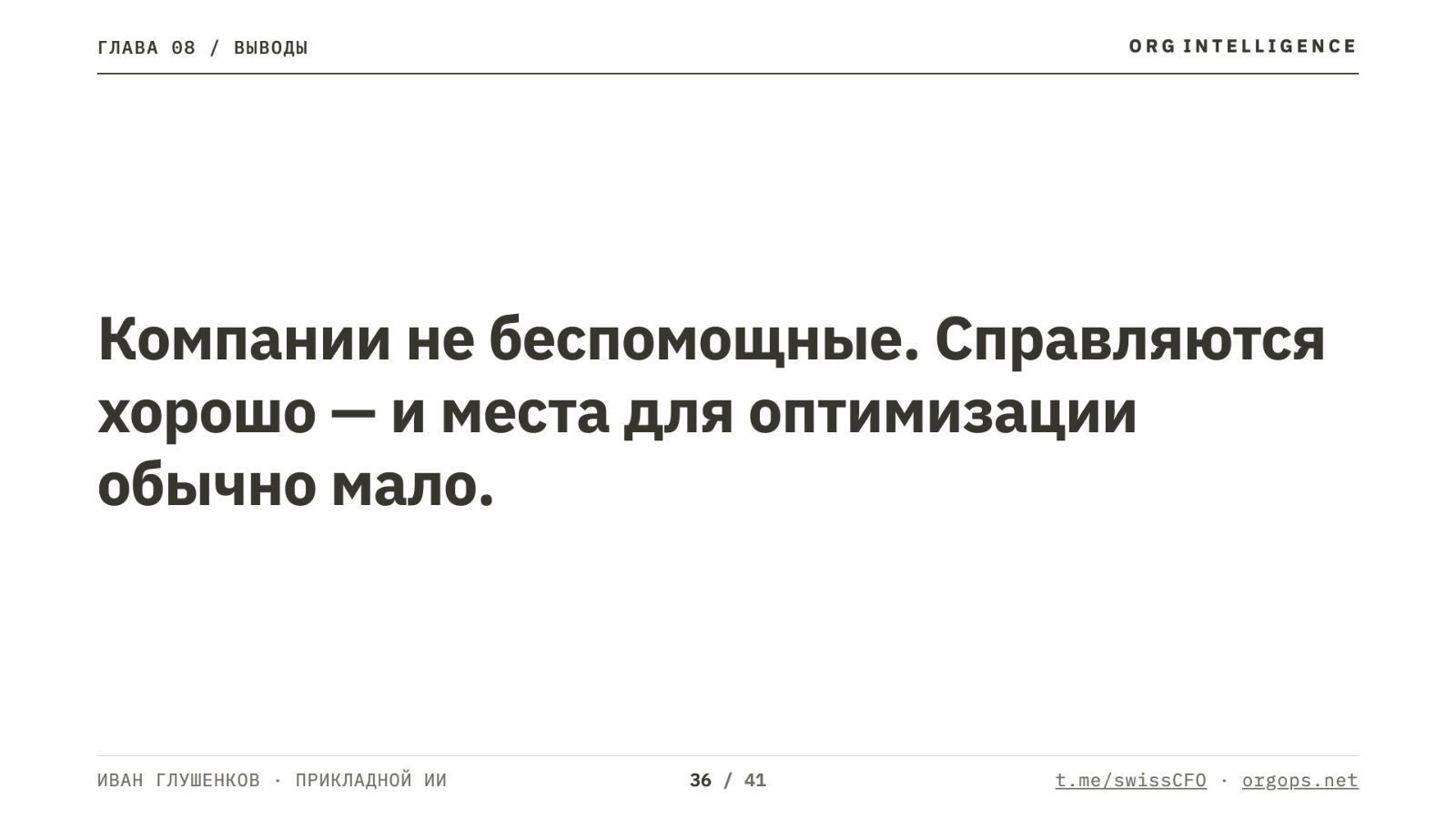
- 1:14 — "No 10x. But 10% of EBITDA is a good target." Sometimes 20–30%.
37. A local maximum · ≈1:14–1:15
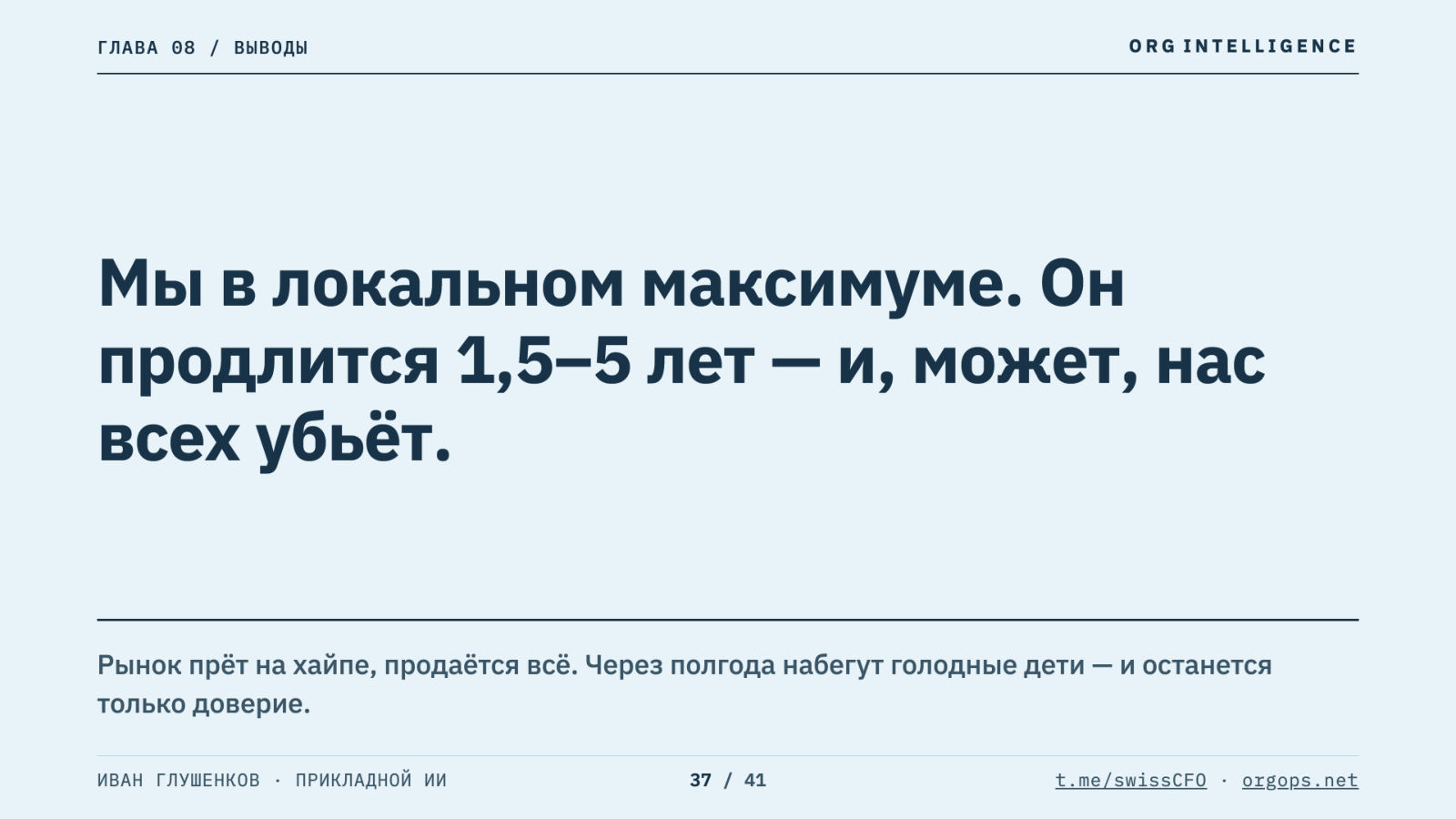
- 1:14 — The model will last from a year and a half to five years. "Right now everything sells… You could copy this presentation and go and say the same words, and practically nobody would tell the difference."
38. What to read · ≈1:15–1:16
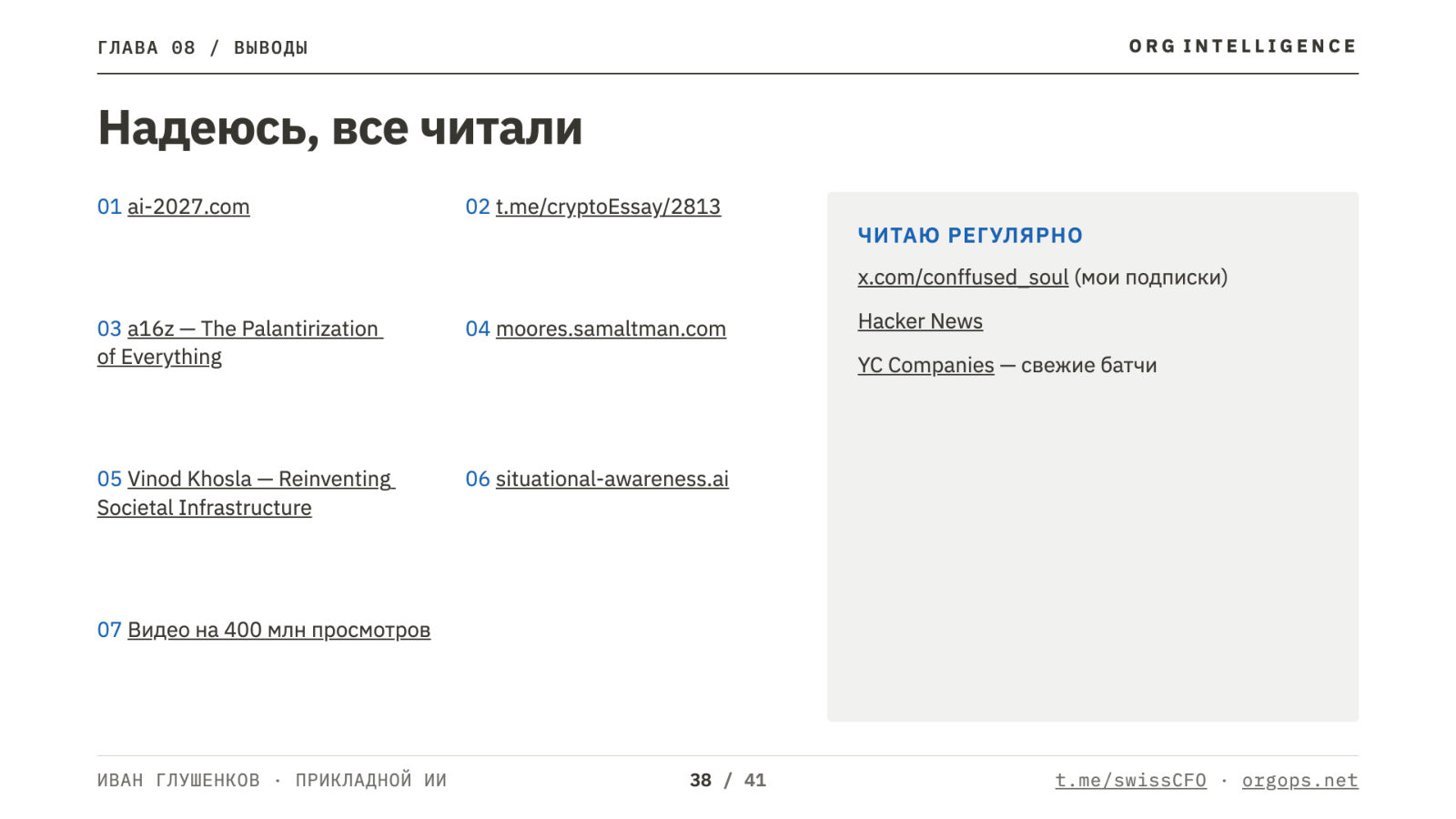
- 1:15 — The articles on the slide, Hacker News, YC, the accounts Ivan follows on X. "And again, feed them to your agents."
39. What to do and what not to do · ≈1:16–1:17
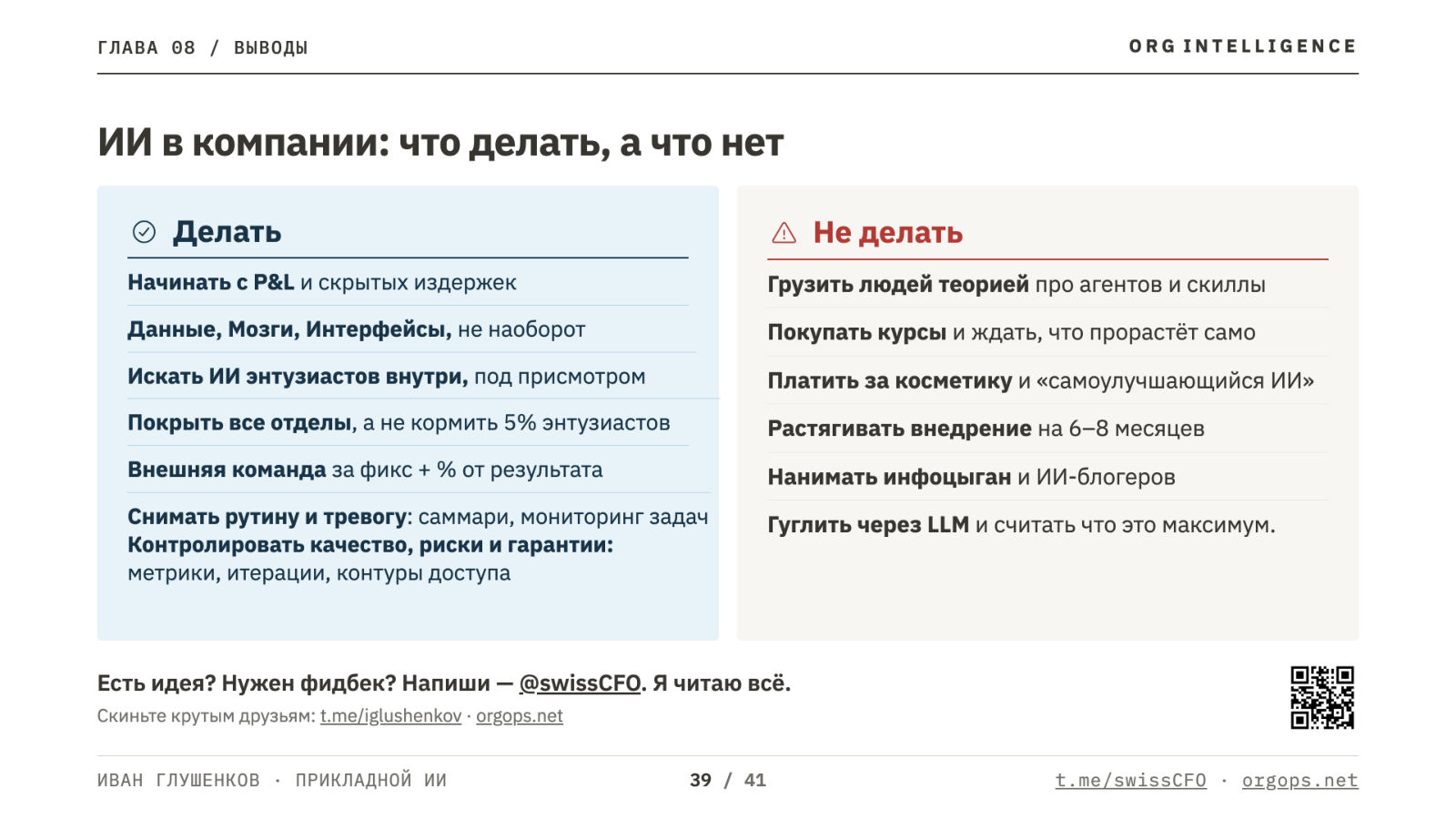
- 1:16 — Do: start quietly, without "pioneers"; separate data, brains and interfaces; grow enthusiasts under supervision; cover every department for the sake of EBITDA; an external team on a fixed fee + a percentage; take away the everyday anxiety and control the risks.
- 1:16 — Don't: load people up with theory; pay for cosmetics or for teams "that will be afraid to actually do anything"; drag it out ("better… to find out quickly that it's crap"); hire course-selling gurus whose ceiling is "the scale of three people."
Questions and answers
40. Playbook · spoken questions · ≈1:17–1:43
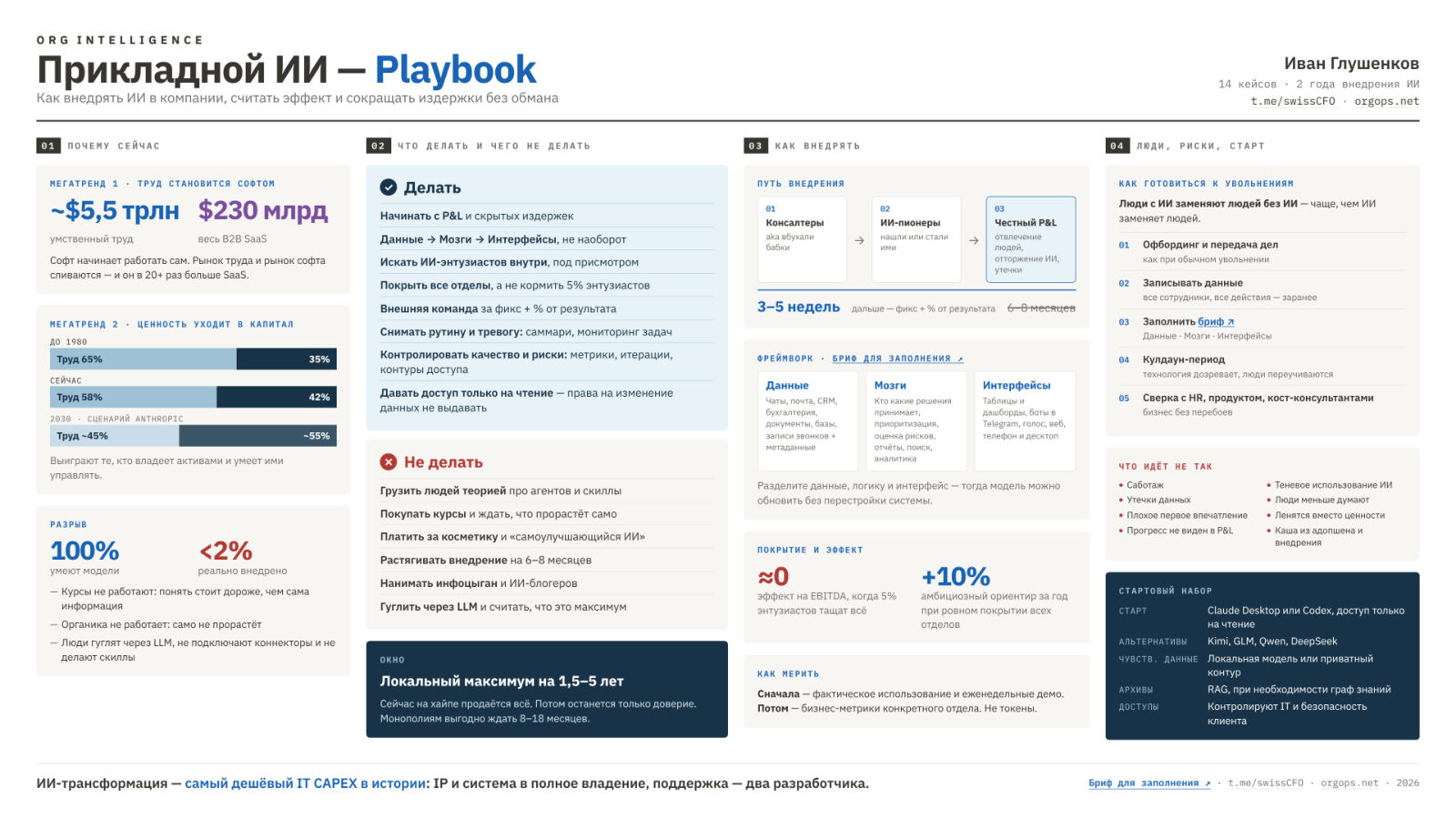
- 1:18 — Where to start? Claude Desktop ("not in the browser") or Codex; connect email, the CRM, the databases. "And then you get the aha moment." Without data, Claude is "a kid who doesn't really get it." After that, a spoken brief with ChatGPT or 2 hours of setup.
- 1:21 — Can Claude delete the CRM? It can, which is why everything is read-only. "It's always better with a guide… I tried to learn to do everything on my own, and that was a big mistake."
- 1:23 — Dmitry: prototypes versus serious engineering. They are "completely opposite… competencies." "The ones who always win… are people with AI, competent people." There were 45 candidates for Head of AI Engineering: seven understood the task, one and a half or two got it done.
- 1:28 — Nikita: what can replace Claude? An external service with unrestricted models (check the jurisdiction), your own local model on a Mac of up to $10k with 128 GB, a private cloud at ≈$10k a month. Chinese models are "really the same" as Opus.
- 1:33 — A local model "will run on electricity alone," without Wi-Fi. For a supplier of alloys to the French army, an ordinary MacBook is enough.
- 1:35 — Security of Chinese models. Look at who is behind the company, the terms and where data is stored. Kimi has "switch to China site," plus a VPN.
- 1:38 — Macs in different offices with remote access? "Yes, absolutely… Swiss banks do the same." Why a Mac: Ivan doesn't know of any Windows laptops with 128 GB.
- 1:39 — Artur: merchant onboarding. "The customer doesn't need AI" — put it into the back office. At a payments company with 500 chats, the first thing built was a bot that "reads every chat and nudges everyone."
- 1:41 — Artur: health. A Healthcare 2030 lecture for 40 doctors. "A wild boom in longevity." ChatGPT is "on the whole a good personal doctor." There is no in-house case.
- 1:43 — A request from the audience to move on to the written questions: "somebody took the trouble to put theirs into a single sentence."
41. Questions and answers · chat and close · ≈1:43–2:14
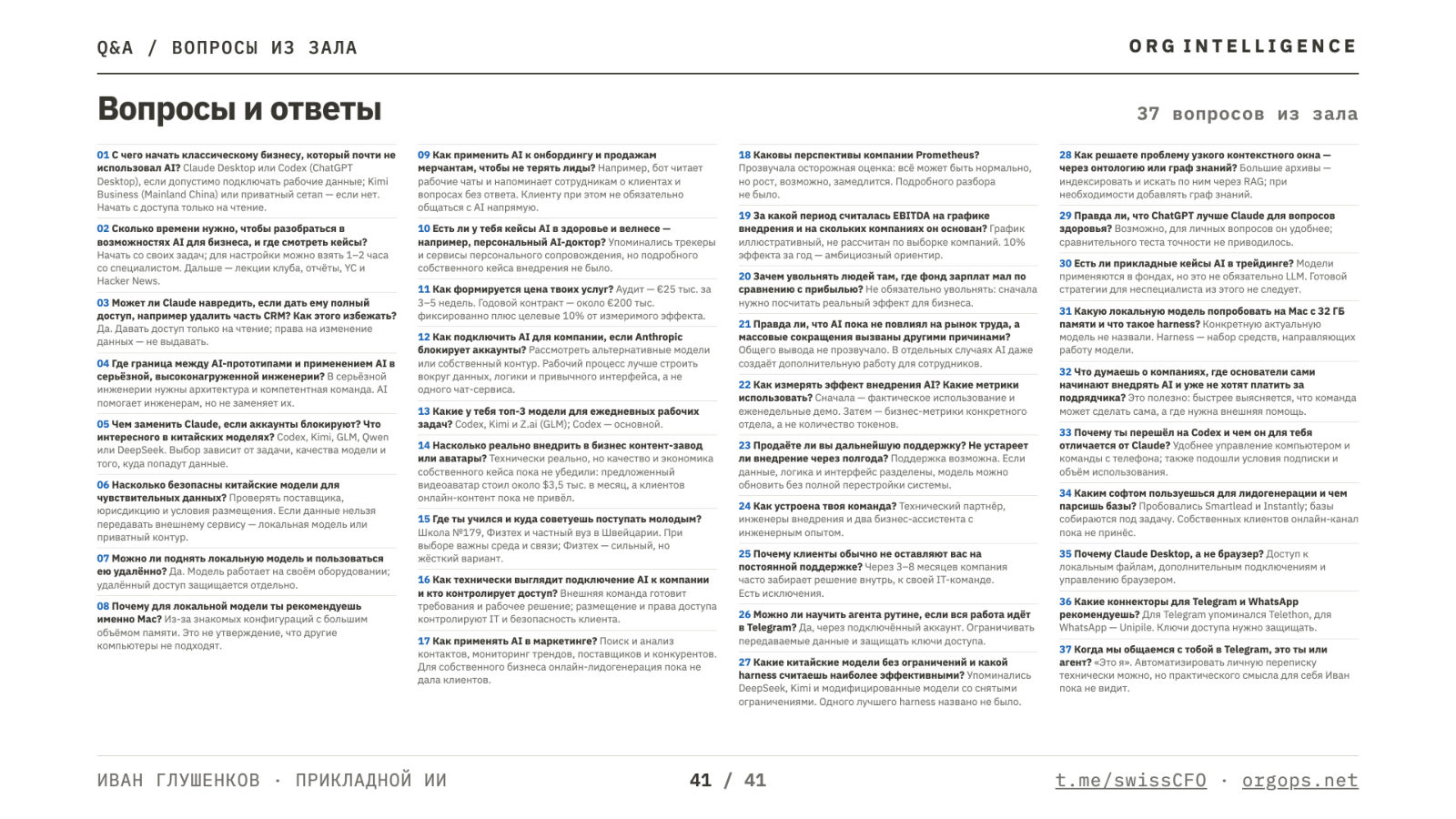
- 1:43 — Price. The filter is an effect of at least €100k a month. An audit is €25k over 3–5 weeks; a year is ≈€200k fixed + 10% of what is saved.
- 1:44 — If Anthropic blocks you. Kimi, Z.ai, the DeepSeek harness, Cursor. "A business needs a clear, familiar interface… and good data."
- 1:46 — Top 3 models. Codex, Kimi, Z.ai (GLM). "Anything above Opus 4.8 works perfectly for 99% of tasks."
- 1:48 — Avatars and content factories. $3,500 a month is expensive. "Zero clients from the internet… Everything comes only through personal contacts and the banya."
- 1:49 — Education. School 179, the FIVT faculty at MIPT, a private university in Switzerland. "The network decides everything."
- 1:51 — Root access. It always stays with the client's security and IT people; the team brings a finished bot or dashboard to be hosted inside the client's perimeter.
- 1:52 — Marketing. He recommends Denis S. He built his own databases of alumni (31,000) and of conference contacts (22,000 at SiGMA).
- 1:55 — Prometheus — "it's all fine, but… not that fast." EBITDA on the chart — an illustration; the target is +10% in a year.
- 1:56 — Why lay people off if payroll is small? "Absolutely the right question." At a payments company, people are at most 10% of EBITDA. A 700-person support team in iGaming is another matter.
- 1:58 — How to measure. First, whether people use it at all ("30 subscriptions… seven or nine"). A demo once a week, then "I take Claude away from 90% of people": chat is "an ultra-inefficient interface." After that, the department's metrics.
- 2:01 — Will it go stale? No: the data and the interfaces don't change, and the model gets updated. Salesforce: $70k+ over 6 months with the vendor; agents finished the job in 3 days.
- 2:03 — The team. A technical partner, forward deployed engineers, two business assistants. LTV is 3–8 months, after which the solution moves into the client's IT.
- 2:05 — Telegram/WhatsApp, uncensored models. A separate account. "I love Qwen, I love GLM."
- 2:06 — "Two hours already." Narrow context: a proper RAG + a knowledge graph. Claude "starts getting dumb at two or three hundred documents."
- 2:07 — Longevity, ChatGPT vs Claude on health, trading. The median will shift by 2–4 years, but progress is exponential. ChatGPT is probably more convenient for health. Trading: "I don't recommend it."
- 2:08 — A harness is "a bridle" for "a smart, powerful horse." A model for a 32 GB Mac: "Ask your local model that."
- 2:09 — Founders coding for themselves? "I'm all for it… It only saturates the market." Why Codex: computer use, the phone, more credits.
- 2:10 — Lead generation: Smartlead, Instantly, "not a single client from online." Desktop, not the browser: files, connectors, browser control. Connectors: Telethon, Unipile.
- 2:11 — "Is that you or an agent?" "It's me." There is no point optimizing personal things: "why sweat over pennies?"
- 2:11 — Mikhail: "2 hours 11 minutes… you went like a machine gun." Sergey will talk about his setup next Saturday at 10:00.
- 2:14 — Ivan: "I'm amazed by the turnout online. Let's keep talking."
If you want to work out where AI would pay off in your own company, message me on Telegram: t.me/swissCFO.